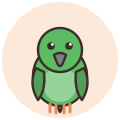
Eclectus Parrot
Eclectus roratus
Also called Eclectus, Moluccan eclectus, Grand eclectus, Vosmaeri eclectus, Solomon Island eclectus
From Islands of eastern Indonesia, New Guinea, the Solomon Islands and the tip of Cape York Peninsula in northern Australia. The Moluccan eclectus (E. roratus) lives on the Maluku Islands, while the Papuan eclectus (E. polychloros) ranges from the Kai Islands across New Guinea and nearby archipelagos to the Solomons and Cape York. It favours tropical rainforest and monsoon forest.123
At a glance the quick version
LafeberVet gives 30-40 years as typical in captivity with 50-60 reported as a maximum; Wikipedia notes reported lifespans ranging from about 20 to over 60 years.
Looks how to spot one
Feathered; stocky, short-tailed parrot with striking colour difference between the sexes
A chunky, medium-sized parrot around 31-37 cm long, with a short square tail and a wingspan near 50 cm. The two sexes look like different birds. Males are a glossy bright green with a yellowish tinge on the head, blue in the flight feathers, red on the flanks and under the wings, and a candy-corn beak of orange fading to yellow. Females are a deep, rich red with purple to blue on the chest and mantle, and an all-black beak. The body feathers are fine and almost hair-like, giving a soft, silky look. Adults have yellow-orange eyes, while youngsters start with dark eyes.1534
Personality what they are like
A bright, observant bird that tends to be calmer and quieter than many parrots of similar size. Eclectus can learn to copy words and household sounds and also make soft coos, whistles and laughs. Hens often have a bolder, more assertive nature, while cocks can be gentler and a little more reserved, so a hen may suit a keeper who already has some parrot experience. They often like time to get used to new things before joining in.431
Daily activity how busy a day looks
Needs daily time out of the cage to climb, stretch and fly where safe, plus chewing toys and foraging tasks to keep its clever mind busy. In the wild males travel long distances each day to find food, so regular movement and exploring suit this bird well.41
Grooming and care the hands-on bits
Offer regular baths or gentle misting to help keep the plumage in good order, and provide perches of about 2.5 cm diameter plus safe chewing items to wear down the beak naturally. A diet rich in fresh produce is central to everyday care for this species.4
Home where they are happiest
A strong, roomy cage of at least 61 x 91 x 122 cm is the suggested minimum, with bar spacing of 1.9-3.8 cm and perches around 2.5 cm across. Larger is better, together with a safe play area outside the cage. Its native home is warm, humid tropical forest.43
Food basics what goes in the bowl
In the wild it eats mostly fruit, figs, unripe nuts, flower and leaf buds, nectar and some seeds. Eclectus have an unusually long digestive tract suited to fibre-rich food, so a pet diet should lean on a good formulated diet plus plenty of fresh fruit, vegetables and whole grains. Grit is not needed.143
Company who they like around
A social parrot that lives in groups in the wild and does best with daily interaction, training and company. In nature a single female may be looked after by several males, and dominant pairs can have helper birds, so this is a species built around cooperation.613
The story where it all began
The Moluccan eclectus was described by Müller in 1776, and Johann Georg Wagler set up the genus Eclectus in 1832, taking the name from a Greek and Latin word meaning 'chosen one'. Because hens and cocks look so different, European naturalists long treated them as two separate species, and it was not until the early 20th century that everyone accepted they were one bird. For most of the 20th century all forms were grouped as one species with many subspecies, some of which became firm favourites in aviculture, such as the Vosmaeri, Solomon Island and red-sided eclectus. Long-term field studies at Iron Range National Park in Queensland, run across eight breeding seasons from 1997 to 2005, showed that competition among females for scarce, dry nest hollows shapes the unusual sex roles of this parrot. In 2023 the IOC followed IUCN and BirdLife International in splitting the group into four species: Moluccan, Sumba, Tanimbar and Papuan eclectus. A fifth, the oceanic eclectus of Vanuatu, Fiji and Tonga, disappeared around 3,000 years ago.5174
Fun facts for the dinner table
- 1
Male and female eclectus look so unlike each other that early naturalists thought they were two different species.5
- 2
It is one of the few birds where the female is the more colourful one: hens are brilliant red and purple, cocks are leaf green.5
- 3
Males carry ultraviolet colour in their feathers, which females can see, while predators that cannot see ultraviolet still find them well camouflaged.5
- 4
Females can stay at their chosen tree hollow for up to 11 months of the year, guarding it from rivals.1
- 5
Up to five males may regularly bring food to one female, and males may fly up to 20 km from the nest to forage.1
- 6
Studies in Queensland found that females with drier nest hollows raised more chicks and attracted more males to feed them.7
- 7
The genus name Eclectus comes from an ancient Greek and Latin term meaning 'chosen one'.5
- 8
Besides copying speech, eclectus make tones, coos, whistles and even laugh-like sounds.3
Recognised by the official bits
- IOC World Bird List
- In 2023 the single eclectus species was split into four: Moluccan eclectus (E. roratus), Sumba eclectus (E. cornelia), Tanimbar eclectus (E. riedeli) and Papuan eclectus (E. polychloros). IUCN and BirdLife International had already made the split. Pet birds sold as 'eclectus' may belong to either the Moluccan or Papuan forms.5
- IUCN Red List
- Moluccan eclectus (E. roratus) listed as Least Concern.1
- CITES
- Appendix II.3
- Taxonomy
- Species described by Müller in 1776; genus Eclectus named by Johann Georg Wagler in 1832.5
The care rhythm Furry Diary remembers it for you
A typical home-care rhythm for a Eclectus Parrot. It is our own starting plan, not a vet's advice, and you can change every line in the app.
- Fresh food and waterevery day
- Cage linerevery day
- Full cleanevery week
- Bath offerevery 3 days
- Nails checkevery month
- Beak checkevery month
- EnrichmentPuzzles and foraging every dayevery day
- Out-of-cage timeAbout 3 hours a dayevery day
- Vet check-upevery year
You might also like
 African Grey Parrot
Like what we are building? Buy us a coffee.
The breed atlas is free for everyone, with a source on every fact, and it will never show ads. If it helped you, a small tip keeps the research going. Any amount is lovely, and no is a perfectly fine answer too.
Where this comes from
Every breed page shows where each fact comes from. If we got something wrong, sorry, we are pet people, not a science magazine. Tell us at [email protected] and we will fix it.
- Moluccan eclectus - Wikipedia en.wikipedia.orgused for range, plumage, subspecies, wild diet, breeding behaviour, conservation status, fun facts
- Papuan eclectus - Wikipedia en.wikipedia.orgused for range of Papuan forms, relative size
- Grand Eclectus Parrot Facts - SeaWorld seaworld.orgused for length, wingspan, weight, habitat, diet, vocalisations, helpers at the nest, CITES
- Basic Information Sheet: Eclectus Parrot - LafeberVet lafeber.comused for length, weight, lifespan, cage size, bar spacing, perches, captive diet, temperament
- Eclectus - Wikipedia en.wikipedia.orgused for taxonomy and 2023 split, etymology, history, ultraviolet colouring, lifespan range, extinct species
- Eclectus roratus - Animal Diversity Web animaldiversity.orgused for social behaviour and mating system
- The ecological basis of unusual sex roles in reverse-dichromatic eclectus parrots - Animal Behaviour sciencedirect.comused for nest hollow competition research, history
Checked 2026-09-30. Text is written in our own words from these sources.