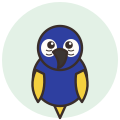
Hyacinth Macaw
Anodorhynchus hyacinthinus
Also called Hyacinthine macaw, Blue macaw
From Central South America: the Pantanal of Brazil, Bolivia and Paraguay, the cerrado of eastern Brazil, and open areas along major Amazonian rivers. It lives in palm savanna, forest edges and open dry woodland with gallery forest and palm stands.12
At a glance the quick version
Looks how to spot one
Feathered; the largest flying parrot, with a massive beak and long tail
An enormous macaw, about a metre long, dressed almost entirely in rich cobalt to violet blue, a little darker on the wings and paler on the head. It has a bright yellow ring of bare skin around each dark eye and a yellow crescent of bare skin along the base of the lower beak. The huge beak is grey-black, and the undersides of the wings and tail look dark. Males and females look alike.12
Personality what they are like
Often called the gentle giant of the parrot world. Hand-raised hyacinths are usually docile and very affectionate, and they love to play, though that play involves a very strong beak, so owners learn to guide it. They learn a few favourite words rather than a large vocabulary, and their calls are extremely loud. They suit experienced keepers with a lot of space and time.32
Daily activity how busy a day looks
Very high. Needs many hours of daily free time with people, room to climb and fly, and a constant supply of branches and wooden toys to chew.3
Grooming and care the hands-on bits
Provide heavy-duty wooden toys, branches and sturdy play structures, replacing chewed items often.3
Home where they are happiest
Standard cages are too small. Plan for a custom stainless-steel or the largest commercial cage, or ideally a bird room or large outdoor flight.32
Food basics what goes in the bowl
Nuts are central: in the wild they eat mostly palm nuts, and at home they need a steady supply of nuts such as Brazil nuts, walnuts, macadamias, almonds and coconut, plus daily fruit, vegetables and a formulated food.312
Company who they like around
Very social; wild birds live in pairs and small groups. It needs plenty of company and does not do well left alone for long periods.3
The story where it all began
John Latham described the hyacinth macaw in 1790 from a museum specimen in London. As the largest flying parrot it has always drawn attention, and today it is the focus of conservation work such as the Hyacinth Macaw Project in Brazil, which puts up nest boxes and monitors the birds.2
Fun facts for the dinner table
- 1
It is the largest flying parrot in the world, reaching about 1 m from head to tail tip.2
- 2
Its beak can crack coconuts, Brazil nuts and macadamias.2
- 3
Some palm nuts they eat have first passed through cattle, which removes the fleshy outer layer, so hyacinths pick them out of dung.1
- 4
They have been seen using pieces of wood or leaves to hold nuts steady while cracking them, a simple form of tool use.2
- 5
Chicks stay in the nest for about 110 days and depend on their parents until about six months old.2
Recognised by the official bits
- Taxonomy
- Described by John Latham in 1790 as Psittacus hyacinthinus, from a specimen in the Leverian Museum. No subspecies.2
- IUCN Red List
- Vulnerable.1
- CITES
- Appendix I.1
- Legal protection
- Protected by law in Brazil and Bolivia.2
How many About 6,500 wild birds (estimate as of 2004, Wikipedia). World Parrot Trust gives 4,700-11,000 mature individuals, stable (year not stated).21
The care rhythm Furry Diary remembers it for you
A typical home-care rhythm for a Hyacinth Macaw. It is our own starting plan, not a vet's advice, and you can change every line in the app.
- Fresh food and waterevery day
- Cage linerevery day
- Full cleanevery week
- Bath offerevery 3 days
- Nails checkevery month
- Beak checkevery month
- EnrichmentPuzzles and foraging every dayevery day
- Out-of-cage timeAbout 3 hours a dayevery day
- Vet check-upevery year
You might also like
 Blue-and-gold Macaw
 Green-winged Macaw
Like what we are building? Buy us a coffee.
The breed atlas is free for everyone, with a source on every fact, and it will never show ads. If it helped you, a small tip keeps the research going. Any amount is lovely, and no is a perfectly fine answer too.
Where this comes from
Every breed page shows where each fact comes from. If we got something wrong, sorry, we are pet people, not a science magazine. Tell us at [email protected] and we will fix it.
- Hyacinth Macaw - World Parrot Trust Parrot Encyclopedia parrots.orgused for names, size, weight, range, habitat, plumage, wild diet, lifespan, conservation, fun fact
- Hyacinth macaw - Wikipedia en.wikipedia.orgused for taxonomy, size, range, diet, tool use, breeding, captive care, population estimate, conservation
- Hyacinth Macaw - Lafeber lafeber.comused for temperament, talking, noise, activity, housing, diet, social needs, lifespan
Checked 2026-09-30. Text is written in our own words from these sources.