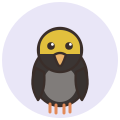
Masked Lovebird
Agapornis personatus
Also called Yellow-collared lovebird, Black-masked lovebird, Black-faced lovebird, Black-headed lovebird
From East Africa: northern and central Tanzania, in well-wooded grassland with acacia and commiphora at about 1,100-1,800 m. Introduced populations live in coastal Tanzania and in Kenya and Burundi.12
At a glance the quick version
Looks how to spot one
Feathered; small, stocky short-tailed parrot
The wild-type bird wears a blackish-brown mask over the face and crown, a bright yellow collar and chest, and a green body and wings. The throat has an orange-red wash, the bill is deep red and a bare white ring surrounds each eye. Males and females look alike.12
Personality what they are like
Lively, curious and chatty. It keeps up a steady stream of chirps and whistles and prefers to talk to other birds rather than copying words. White eye-ring lovebirds are often described as somewhat less quarrelsome than peach-faced lovebirds.32
Daily activity how busy a day looks
High energy. Needs daily out-of-cage flying or a roomy aviary, with chew toys, branches and things to shred.13
Grooming and care the hands-on bits
Enjoys bathing; a shallow water dish or a light overhead mist suits it well. Rotate toys and natural perches regularly.1
Home where they are happiest
A large cage or aviary, ideally 1.2 m or more in length, furnished with chew toys, branches and room to fly short distances.13
Food basics what goes in the bowl
Wild birds eat grass seeds, millet and sorghum. Pets do best on a formulated diet or quality seed mix topped up with fresh vegetables and some fruit, rather than seed alone.13
Company who they like around
Naturally lives in small flocks and nests in colonies. A pair bonds closely; a single bird needs lots of daily company from its family.123
The story where it all began
Anton Reichenow described the species in 1887 from Tanzania. It became a favourite of aviculturists, and a blue form found among wild birds in the 1920s was the first colour mutation known in any lovebird.2
Fun facts for the dinner table
- 1
Its blue mutation, first found in wild birds in the 1920s, is the oldest known colour mutation in the whole lovebird genus.2
- 2
It builds a surprisingly complex domed nest inside a tree hollow, using grass stalks and strips of bark.1
- 3
Flocks usually hold four or five birds but can gather in groups of up to 100.1
- 4
During courtship the male bobs his head and shuffles eagerly towards the female.2
Recognised by the official bits
- Taxonomy
- Described by Anton Reichenow in 1887; a white eye-ring lovebird of the genus Agapornis.2
- IUCN Red List
- Least Concern.1
- CITES
- Appendix II.1
- Aviculture
- Listed as common in captivity by the World Parrot Trust.1
The care rhythm Furry Diary remembers it for you
A typical home-care rhythm for a Masked Lovebird. It is our own starting plan, not a vet's advice, and you can change every line in the app.
- Fresh food and waterevery day
- Cage linerevery 2 days
- Full cleanevery week
- Bath offerA shallow dish or gentle mistevery 3 days
- Nails checkevery month
- Toy rotationevery 2 weeks
- Out-of-cage timeAbout an hour a day, if tameevery day
- Vet check-upevery year
You might also like
 Fischer's Lovebird
 Peach-faced Lovebird
Like what we are building? Buy us a coffee.
The breed atlas is free for everyone, with a source on every fact, and it will never show ads. If it helped you, a small tip keeps the research going. Any amount is lovely, and no is a perfectly fine answer too.
Where this comes from
Every breed page shows where each fact comes from. If we got something wrong, sorry, we are pet people, not a science magazine. Tell us at [email protected] and we will fix it.
- World Parrot Trust - Masked Lovebird parrots.orgused for size, weight, range, diet, lifespan, status, aviculture
- Wikipedia - Yellow-collared lovebird en.wikipedia.orgused for history, mutations, behaviour, introduced populations
- Lafeber - Lovebird lafeber.comused for temperament, housing, diet, social needs, lifespan
Checked 2026-09-30. Text is written in our own words from these sources.