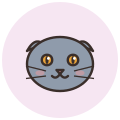
Owl mode activated.
Scottish Fold
Felis catus
Also called Fold, Lop-eared cat (original name), Highland Fold (longhair), Scottish Fold Longhair, Longhair Fold
From Scotland, United Kingdom: descended from Susie, a white farm cat with folded ears found near Coupar Angus in 1961; much of the later development took place in the United States123
At a glance the quick version
Wikipedia gives 4-6 kg for males and 2.7-4 kg for females. TICA gives 7-10 lb (about 3.2-4.5 kg) for the breed and PetMD up to 13 lb (about 5.9 kg).
Coat and looks how to spot one
short plush coat or medium-long coat
Roundness is the theme: a round head, big round eyes, round whisker pads and a compact, well-padded body on sturdy legs with a short neck. In fold-eared cats the ears bend forward and down so they sit on the head like a snug cap, giving an owl-like face. The shorthair has a dense, springy coat that stands out from the body. The longhair has a longer, soft coat with a plumed tail, breeches, toe tufts and ear furnishings.321
Personality what they are like
A gentle, easygoing homebody that likes company without being clingy. Folds tend to follow their people from room to room and chat in a small, polite voice. They are clever and can learn tricks, get on well with children and other pets when properly introduced, and may be a little shy with strangers at first.324
Daily activity how busy a day looks
Moderate. Enjoys wand toys, interactive play and puzzle games, plus a scratching post and a sunny spot to lounge. Short daily play sessions suit it well.42
Grooming and care the hands-on bits
Shorthairs need a brush or comb about once a week; longhairs need combing a few times a week to keep tangles away. Both shed through the year. Add routine nail trims, ear cleaning and tooth brushing, and always handle the tail gently.234
Home where they are happiest
Settles happily in a house or an apartment. Provide comfy resting places, a scratching post and toys for daily play.4
Company who they like around
A people-loving cat that prefers company and does not enjoy being left alone for long stretches. Mixes well with children and other pets after proper socialisation.324
The story where it all began
In 1961 shepherd William Ross noticed Susie, a white farm cat with oddly folded ears, near Coupar Angus in the Tayside region of Scotland. When Susie's kittens also showed the folded ears, William and Molly Ross started a breeding programme with help from geneticist Pat Turner. Susie's daughter Snooks became a foundation queen, and early breeders used local farm cats and British Shorthairs, later adding American and Exotic Shorthairs, Persians and Burmese. The cats were first called lop-eared cats after lop rabbits and were renamed Scottish Folds in 1966. Every Fold today traces back to Susie. The breed gained a strong following in North America, reaching CFA championship in 1978, with the longhair following in 1992 and straight-eared cats joining the CFA breed in 2022.123
Fun facts for the dinner table
- 1
Every Scottish Fold alive today can trace its family tree back to one white farm cat, Susie, found in 1961.2
- 2
Fold kittens are born with straight ears, and the fold only starts to show at around 18 to 24 days old.2
- 3
Folds often sit upright on their haunches, a pose fans call the Buddha sit, and may rise up like a prairie dog to check out a sound.2
- 4
The folded ears do not affect how well the cat hears.3
- 5
The breed was first known as lop-eared cats, a nod to lop rabbits, before being renamed in 1966.1
- 6
Pop star Taylor Swift has two Scottish Folds, Meredith Grey and Olivia Benson, named after TV characters.1
- 7
Straight-eared kittens from Fold litters are called Scottish Straights.1
Recognised by the official bits
- CFA
- Shorthair championship status 1978, longhair 1992; straight-eared cats accepted in 2022, giving four divisions3
- TICA
- Recognised in shorthair and longhair; TICA was the first to accept the longhair version (1987-88 season)1
- GCCF
- Not registered; GCCF stopped registering the breed in the early 1970s1
- FIFe
- Not recognised1
The care rhythm Furry Diary remembers it for you
A typical home-care rhythm for a Scottish Fold. It is our own starting plan, not a vet's advice, and you can change every line in the app.
- Brushingevery week
- Nail trimevery 3 weeks
- Teeth brushingDaily brushing is idealevery 2 days
- Litter scoopevery day
- Litter changeevery week
- PlayAbout 20 minutes of play a dayevery day
- Flea, tick and worm protectionSchedule as your vet recommendsas your vet recommends
- Vet check-upSenior years usually start around age 11every year
You might also like
 British Shorthair
 Exotic Shorthair
 American Curl
 Highlander
Like what we are building? Buy us a coffee.
The breed atlas is free for everyone, with a source on every fact, and it will never show ads. If it helped you, a small tip keeps the research going. Any amount is lovely, and no is a perfectly fine answer too.
Where this comes from
Every breed page shows where each fact comes from. If we got something wrong, sorry, we are pet people, not a science magazine. Tell us at [email protected] and we will fix it.
- Scottish Fold - Wikipedia en.wikipedia.orgused for origin, naming, recognition status, weight by sex, coat, fun facts
- TICA breed profile: Scottish Fold tica.orgused for history, weight, lifespan, coat, colours, temperament, behaviours, care
- CFA breed profile: Scottish Fold cfa.orgused for history, recognition dates, appearance, coat, temperament, grooming
- PetMD: Scottish Fold petmd.comused for height, weight, temperament, activity, grooming, living space
Checked 2026-09-30. Text is written in our own words from these sources.