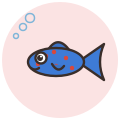
Not furry, but we like them anyway.
Blue Lyretail Killifish
Fundulopanchax gardneri (Boulenger, 1911)
Also called Gardner's killifish, Gardner's killi, Steel-blue aphyosemion, Steel-blue killifish, Blue lyretail
From West Africa: the Cross River and Benue basins of Nigeria and western Cameroon, in streams, marshes and swamps in both savanna and rainforest.123
At a glance the quick version
Seriously Fish 5.5 cm SL; FishBase and Wikipedia 6.5 cm TL
Looks how to spot one
Scaled, elongate killifish
A slim killifish whose bluish males are marked with wavy rows of red spots, with the dorsal, anal and tail fins rimmed in yellow or orange. Females are browner with fewer spots and shorter fins.13
Personality what they are like
A robust, spirited killi. Males squabble with each other and may bother slow fish, so it suits a species tank or tankmates of similar size and energy.13
Daily activity how busy a day looks
An energetic fish and a prodigious jumper.1
Grooming and care the hands-on bits
Use a tight lid. Soft to moderately hard, slightly acidic to neutral water works well. Aquarium stocks are often labelled by collecting locality, such as Akure or Nsukka.12
Home where they are happiest
Temperature about 20-26 °C, pH 6.0-7.5, hardness 1-10 dGH. FishBase suggests at least a 60 cm tank. Give plenty of hiding places so subordinate fish can retreat.12
Food basics what goes in the bowl
Micropredator. Accepts dried foods but should also get live or frozen brine shrimp, daphnia and bloodworm.1
Company who they like around
Keep one male with two or three females; extra hiding spots help when more than one male shares a tank.1
The story where it all began
George Albert Boulenger described it in 1911 from Okwoga on a Cross River tributary in Nigeria. It is named after Captain R. D. Gardner, who collected the first specimens. Hobbyists keep it under many locality names such as Akure and Nsukka.123
Fun facts for the dinner table
- 1
Its eggs can survive a dry spell in the substrate yet also hatch if they stay underwater, a flexible strategy for unpredictable habitats.3
- 2
Eggs typically hatch in about 14-21 days.3
- 3
The species name honours Captain R. D. Gardner, who collected the type specimens.2
- 4
Four subspecies are recognised, including the Nigerian, Mamfe and Ejagham forms.3
Recognised by the official bits
- IUCN Red List
- Least Concern (assessed September 2019)2
- Taxonomy
- Family Nothobranchiidae; described by Boulenger in 1911 as Fundulus gardneri; four subspecies recognised (gardneri, lacustris, mamfensis, nigerianus)3
The care rhythm Furry Diary remembers it for you
A typical home-care rhythm for a Blue Lyretail Killifish. It is our own starting plan, not a vet's advice, and you can change every line in the app.
- FeedingSmall amounts once or twice a dayevery day
- Temperature checkevery day
- Water changeAbout 25% of the waterevery week
- Water testevery week
- Glass cleanevery week
- Filter rinseRinse in old tank water, never tap waterevery month
You might also like
 Lyretail Killifish
 Blue Gularis
 American Flagfish
Like what we are building? Buy us a coffee.
The breed atlas is free for everyone, with a source on every fact, and it will never show ads. If it helped you, a small tip keeps the research going. Any amount is lovely, and no is a perfectly fine answer too.
Where this comes from
Every breed page shows where each fact comes from. If we got something wrong, sorry, we are pet people, not a science magazine. Tell us at [email protected] and we will fix it.
- Seriously Fish: Fundulopanchax gardneri (Steel-blue Killifish) seriouslyfish.comused for names, range, size, water, diet, behaviour, group, dimorphism, strains, egg adaptation
- FishBase: Fundulopanchax gardneri, Blue lyretail fishbase.seused for author and year, distribution, length, environment, IUCN status, etymology
- Wikipedia: Fundulopanchax gardneri en.wikipedia.orgused for other names, description, subspecies, history, breeding facts
Checked 2026-09-30. Text is written in our own words from these sources.