At a glance the quick version
Looks how to spot one
Scaled, elongated burrowing fish with large eyes
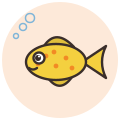
A slender jawfish with big eyes and a large mouth. Adults are yellow to orange or brown and covered in electric-blue spots, with yellow dorsal fins. Courting males turn stark white on the front half of the body, while juveniles are plain yellow with blue spots.2
Personality what they are like
Sociable with its own kind in loose colonies, but it will stand up for its burrow against intruders.2
Daily activity how busy a day looks
Active around its burrow; males dash up into the water above the burrow to court females, and the fish are busiest in the warmer months.2
Grooming and care the hands-on bits
A cool-water species from the Gulf of California rather than a typical tropical reef fish, so it needs a system kept cooler than a standard reef tank. Provide a deep sand and rubble bed for digging and a secure lid.32
Home where they are happiest
A tank with a deep sandy-rubble bottom for burrows. Wild colonies live over sand and rubble on reefs from the surface to about 12 m deep. Exact aquarium temperature figures were not found in reliable sources.123
Food basics what goes in the bowl
Carnivorous. It eats small invertebrates from the bottom and from the plankton; in captivity offer small meaty marine foods.12
Company who they like around
Naturally colonial, living about 1 to 3 m apart in groups that can number in the hundreds. Mouthbrooding pairs form during the breeding season.2
The story where it all began
Gerald Allen and D. Ross Robertson described the species in 1991, making it a fairly recent addition to the list of eastern Pacific reef fishes. Its name honours Richard H. Rosenblatt (1930 to 2014), an ichthyologist at the Scripps Institution of Oceanography.21
Fun facts for the dinner table
Recognised by the official bits
- IUCN Red List
- Least Concern (assessed May 2007)1
- Taxonomy
- Family Opistognathidae; described by Gerald Allen and D. Ross Robertson in 19911
The care rhythm Furry Diary remembers it for you
A typical home-care rhythm for a Bluespot Jawfish. It is our own starting plan, not a vet's advice, and you can change every line in the app.
- FeedingSmall amounts once or twice a dayevery day
- Temperature checkevery day
- Salinity checkevery week
- Top-upTop up evaporation with fresh RO water, not salt waterevery day
- Water testevery week
- Water changeAbout 10 to 20% of the waterevery 2 weeks
- Glass cleanevery week
You might also like
 Yellowhead Jawfish
Like what we are building? Buy us a coffee.
The breed atlas is free for everyone, with a source on every fact, and it will never show ads. If it helped you, a small tip keeps the research going. Any amount is lovely, and no is a perfectly fine answer too.
Where this comes from
Every breed page shows where each fact comes from. If we got something wrong, sorry, we are pet people, not a science magazine. Tell us at [email protected] and we will fix it.
- FishBase: Opistognathus rosenblatti fishbase.seused for origin, size, depth, behaviour, IUCN status
- Wikipedia: Opistognathus rosenblatti en.wikipedia.orgused for description, colours, colonies, reproduction, etymology
- Reef Builders: Cool-water marine species sometimes sold as tropicals reefbuilders.comused for cool-water care requirement
Checked 2026-09-30. Text is written in our own words from these sources.