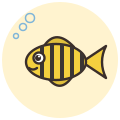
Not furry, but we like them anyway.
Bumblebee Cichlid
Pseudotropheus crabro (Ribbink & Lewis, 1982)
Also called Hornet Cichlid, Bumblebee Mbuna, Melanochromis crabro, Maylandia crabro
From Endemic to Lake Malawi, East Africa: reefs and islands including Eccles Reef, Maleri, Mbenji, Likoma and Chisumulu Islands and Nkhata Bay, often near large caves and boulders.12
At a glance the quick version
Looks how to spot one
Elongated rock-dwelling mbuna
A long-bodied cichlid striped in yellow and black, much like a bumblebee. Youngsters are the brightest; adults, males especially, become darker.2
Personality what they are like
Hardy but very assertive. It is best in a species tank or with other robust mbuna, as one male with several females.2
Daily activity how busy a day looks
Active and curious; in the wild it follows large catfish and explores around caves and boulders.21
Grooming and care the hands-on bits
Keep stable, hard, alkaline water with good filtration and regular partial water changes, plus plenty of large rocks and caves.12
Home where they are happiest
Rocky aquarium with caves and big stones, temperature 24-26 C and pH 7.5-8.2. No reliable minimum tank size found.1
Food basics what goes in the bowl
In nature it picks parasites off the kampango catfish and also eats opportunistically; in aquariums it accepts a wide variety of foods.12
Company who they like around
Keep as one male with several females, either alone or among other sturdy mbuna.2
The story where it all began
It was described by Ribbink and Lewis in 1982 as Melanochromis crabro and has since been moved to Maylandia and then Pseudotropheus. Its common names, bumblebee and hornet cichlid, come from its yellow and black striping.21
Fun facts for the dinner table
- 1
It works as a cleaner fish for the large kampango catfish, picking off fish lice.2
- 2
It can switch quickly to dark brown, which helps it approach the catfish's guarded nest.2
- 3
Wild individuals sometimes swim up to divers, possibly to check them over like they check catfish.2
- 4
It lives at depths of roughly 15 to 18 metres.1
Recognised by the official bits
- IUCN Red List
- Least Concern (assessed 20 June 2018)1
- Taxonomy
- Described in 1982 by Ribbink & Lewis as Melanochromis crabro; later Maylandia, now Pseudotropheus2
The care rhythm Furry Diary remembers it for you
A typical home-care rhythm for a Bumblebee Cichlid. It is our own starting plan, not a vet's advice, and you can change every line in the app.
- FeedingSmall amounts once or twice a dayevery day
- Temperature checkevery day
- Water changeAbout 25% of the waterevery week
- Water testevery week
- Glass cleanevery week
- Filter rinseRinse in old tank water, never tap waterevery month
You might also like
 Auratus Cichlid
 Kenyi Cichlid
 Red Zebra Cichlid
Like what we are building? Buy us a coffee.
The breed atlas is free for everyone, with a source on every fact, and it will never show ads. If it helped you, a small tip keeps the research going. Any amount is lovely, and no is a perfectly fine answer too.
Where this comes from
Every breed page shows where each fact comes from. If we got something wrong, sorry, we are pet people, not a science magazine. Tell us at [email protected] and we will fix it.
- FishBase: Pseudotropheus crabro fishbase.seused for taxonomy, size, water, distribution, IUCN, diet
- Wikipedia: Pseudotropheus crabro en.wikipedia.orgused for names, colour, diet, behaviour, care, history, fun facts
Checked 2026-09-30. Text is written in our own words from these sources.