At a glance the quick version
FishBase gives a common length of 2.5 cm and a maximum of 5.0 cm total length; Seriously Fish gives 5 cm maximum standard length
Aquarium Source reports 5 to 7 years on average, with some reaching about 8
Looks how to spot one
Small scaled cyprinid (barb)
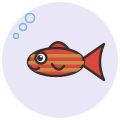
A small, neatly built barb with a gently arched back. A dark line runs along each side from the snout to the base of the tail, and the scales above it are finely edged in darker tones, giving a net-like look. Males are slimmer and smaller, and turn a rich cherry red, especially when ready to spawn. Females are fuller-bodied and a softer tan with a reddish wash.234
Personality what they are like
Calm, gentle and a little shy when kept in small numbers. In a proper group it becomes much bolder and more active, and males put on colourful displays for the females. Unlike some of its barb relatives it is not a fin-nipper, so it fits well into a peaceful community tank.234
Daily activity how busy a day looks
Moderately active, cruising the middle and lower water in loose groups. It is happiest with open swimming room alongside thick planting where it can weave and hide.24
Grooming and care the hands-on bits
Easy to keep. Regular partial water changes and a varied diet keep it lively and colourful. Colours look their best in a well-planted tank with a dark substrate and subdued lighting.23
Home where they are happiest
Aim for a tank with a base of at least 60 x 30 cm (about 54 litres); hobby guides range from about 40 litres for a group of six up to 100 litres or more for a larger school. Temperature roughly 20 to 27 C (23 to 27 C is the commonly quoted tropical range), pH 6.0 to 8.0 and hardness about 2 to 20 dGH. Recreate its shaded forest streams with plenty of plants, leaf litter, a sandy or fine substrate and gentle flow.2134
Food basics what goes in the bowl
An omnivore. Wild fish graze on algae, diatoms and organic debris and also pick off small insects, worms and crustaceans. In the aquarium offer good small flakes or granules, plus live or frozen treats such as bloodworm, daphnia and brine shrimp, and some plant-based food like spirulina.123
Company who they like around
A schooling fish that should live in a group of at least 5 to 10, ideally with both sexes so males show their best colour. It mixes well with other peaceful fish such as small tetras, livebearers, rainbowfish, gouramis, catfish and loaches.213
The story where it all began
The cherry barb comes only from the rainforest streams of south-western Sri Lanka, where it lives in shallow, shaded, slow-moving water over silt and fallen leaves. It was scientifically described in 1929 by Deraniyagala, and its species name appears to come from a local Sri Lankan name for the fish. The genus name Puntius traces back to a Bengali word for small carp-like fishes. Its colour and easy-going nature made it a fixture of the aquarium hobby, and today it ranks among the most common small cyprinids sold. Sri Lanka no longer allows wild specimens to be exported, so almost all cherry barbs in shops are bred on fish farms, which has also produced ornamental forms such as albino, super red and long-fin. Outside its homeland, populations have also become established in parts of Colombia, Mexico and Panama after being introduced. In the wild it is listed as Vulnerable by the IUCN.1243
Fun facts for the dinner table
- 1
It is found naturally nowhere in the world except a small stretch of Sri Lanka, from the Kelani to the Nilwala river basins.1
- 2
Males deepen to their brightest cherry red when they are ready to spawn and when females are around.2
- 3
A single spawning can scatter around 200 eggs among plants near the water's edge.1
- 4
Its eggs hatch in just one to two days, and the fry are swimming freely within about two days.1
- 5
The genus name Puntius comes from 'pungti', a Bengali word for small carp-like fish.2
- 6
Sri Lanka prohibits the export of wild cherry barbs, so the ones in shops are almost all farm-bred.2
- 7
Unlike its famously nippy cousin the tiger barb, the cherry barb is known for leaving other fishes' fins alone.3
Recognised by the official bits
- IUCN Red List
- Assessed as Vulnerable (VU), August 20191
- Scientific description
- Described by Deraniyagala in 19291
- FishBase
- Listed as highly commercial in the aquarium trade1
The care rhythm Furry Diary remembers it for you
A typical home-care rhythm for a Cherry Barb. It is our own starting plan, not a vet's advice, and you can change every line in the app.
- FeedingSmall amounts once or twice a dayevery day
- Temperature checkevery day
- Water changeAbout 25% of the waterevery week
- Water testevery week
- Glass cleanevery week
- Filter rinseRinse in old tank water, never tap waterevery month
You might also like
 Tiger Barb
 Harlequin Rasbora
 Zebra Danio
Like what we are building? Buy us a coffee.
The breed atlas is free for everyone, with a source on every fact, and it will never show ads. If it helped you, a small tip keeps the research going. Any amount is lovely, and no is a perfectly fine answer too.
Where this comes from
Every breed page shows where each fact comes from. If we got something wrong, sorry, we are pet people, not a science magazine. Tell us at [email protected] and we will fix it.
- FishBase: Puntius titteya (Cherry barb) fishbase.seused for origin, habitat, size, water parameters, IUCN status, describer, diet, spawning
- Seriously Fish: Puntius titteya seriouslyfish.comused for tank size, water parameters, behaviour, diet, dimorphism, etymology, export ban, colour forms, history
- Aquarium Co-Op: Cherry Barb Care Guide aquariumcoop.comused for colours, varieties, temperament, diet, tank size
- Aquarium Source: Cherry Barb care guide aquariumsource.comused for lifespan, introduced populations, colour description, tank size
- Animal Diversity Web: Puntius titteya animaldiversity.orgused for alternative common name (crimson carplet)
Checked 2026-09-30. Text is written in our own words from these sources.