At a glance the quick version
Looks how to spot one
Scaled, compact, oval labyrinth fish
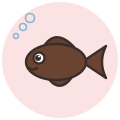
A small, rounded gourami in rich chocolate brown, crossed by several golden bands down the flanks. Colour varies a little by locality. Males have a straight lower jaw and more pointed head; females have a rounded throat.31
Personality what they are like
A peaceful, quiet fish that forms a loose pecking order within its group. It prefers calm surroundings and gentle tankmates.1
Daily activity how busy a day looks
A calm fish that likes a well-planted tank with gentle water movement.13
Grooming and care the hands-on bits
Needs very soft, acidic, clean water with stable conditions; peat or leaf litter helps recreate blackwater. Gentle filtration and a tight lid.1
Home where they are happiest
Tank with a base of at least 60 x 30 cm (about 54 litres), densely planted with dim lighting. Temperature 24-31 °C, pH 4.0-6.5, hardness 0-3 dGH for wild fish (captive-bred fish adapt to up to about 10 dGH).12
Food basics what goes in the bowl
A micropredator that eats tiny crustaceans, worms and insect larvae. Offer live or frozen foods such as brine shrimp nauplii, daphnia, grindal worms and microworms; some learn to take prepared foods.1
Company who they like around
Keep a group of at least six with peaceful, small fish such as small cyprinids and loaches. Avoid boisterous tankmates.1
The story where it all began
Giovanni Canestrini described it in 1860, with the type locality given only as 'Indies'. Its close relative S. selatanensis was split off as its own species from the late 1980s.13
Fun facts for the dinner table
- 1
Instead of a bubble nest, the female carries the eggs in her mouth for about 1-3 weeks and releases fully formed young.1
- 2
Only one other labyrinth fish, its close cousin S. selatanensis, shares this maternal mouthbrooding habit.1
- 3
Its home waters can be extremely acidic, with pH as low as 3-4.1
- 4
Fish sometimes lie on their side and let others mouth their body, a behaviour still not fully understood.1
Recognised by the official bits
- IUCN Red List
- Data Deficient (assessed 18 January 2019)2
- Taxonomy
- Sphaerichthys selatanensis was once treated as a subspecies but is now a separate species3
The care rhythm Furry Diary remembers it for you
A typical home-care rhythm for a Chocolate Gourami. It is our own starting plan, not a vet's advice, and you can change every line in the app.
- FeedingSmall amounts once or twice a dayevery day
- Temperature checkevery day
- Water changeAbout 25% of the waterevery week
- Water testevery week
- Glass cleanevery week
- Filter rinseRinse in old tank water, never tap waterevery month
You might also like
 Licorice Gourami
 Sparkling Gourami
 Honey Gourami
Like what we are building? Buy us a coffee.
The breed atlas is free for everyone, with a source on every fact, and it will never show ads. If it helped you, a small tip keeps the research going. Any amount is lovely, and no is a perfectly fine answer too.
Where this comes from
Every breed page shows where each fact comes from. If we got something wrong, sorry, we are pet people, not a science magazine. Tell us at [email protected] and we will fix it.
- Seriously Fish: Sphaerichthys osphromenoides (Chocolate Gourami) seriouslyfish.comused for standard length, native range, habitat, tank size, temperature, pH, hardness, diet, compatibility, sexing, breeding
- FishBase: Sphaerichthys osphromenoides, Chocolate gourami fishbase.seused for max length, distribution, habitat, water ranges, IUCN status, uses, breeding biology, author and year
- Wikipedia: Chocolate gourami en.wikipedia.orgused for other names, description, taxonomy and history, fun facts
Checked 2026-09-30. Text is written in our own words from these sources.