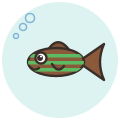
At a glance the quick version
Looks how to spot one
Small, slender, finely scaled fish
A small, torpedo-shaped fish with very fine scales. The sides carry darker blotches or bars over a lighter base. In spawning season males sharpen their contrast, gain red on the throat and belly, and both sexes develop small spawning tubercles.31
Personality what they are like
Peaceful, sociable and busy. Minnows stay close to their shoalmates, prefer fish they know, and are quick to react to danger.13
Daily activity how busy a day looks
A very active swimmer that likes the upper water layers and some current.31
Grooming and care the hands-on bits
Best in a cool, clean, well-oxygenated pond or a large coldwater aquarium with gentle flow and a gravel bottom. Clean, clear water matters more than warmth.312
Home where they are happiest
Cool, clear, oxygen-rich streams and lakes with clean gravel. Preferred water is about 12 to 20 °C (FishBase lists 2 to 20 °C), pH 7.0 to 7.5.123
Food basics what goes in the bowl
Omnivore. Eats insect larvae, small crustaceans such as daphnia, algae and plant bits, and insects that land on the water.231
Company who they like around
A strongly shoaling fish that lives in large groups, so keep it in a sizeable shoal.13
The story where it all began
The minnow has long been a familiar little fish of clear European streams and was traditionally used as bait. Science knows it well too: Karl von Frisch discovered its chemical alarm signal, and it remains an important species in research on fish senses.12
Fun facts for the dinner table
- 1
When a minnow's skin is injured it releases an alarm scent, 'Schreckstoff', that warns the rest of the shoal; Karl von Frisch first described it.1
- 2
Young minnows start shoaling soon after hatching, and by three to four weeks it becomes their main behaviour.1
- 3
In the Alps the minnow lives at up to about 2,000 m above sea level.3
- 4
Minnows can tell how motivated a predator is to attack.1
- 5
Its eggs hatch in about four to five days at 18 °C.2
Recognised by the official bits
- IUCN Red List
- Assessed as Least Concern (2024)2
- Fish of the Year (Germany / Austria)
- Fish of the Year in Germany 1991 and Austria 20163
The care rhythm Furry Diary remembers it for you
A typical home-care rhythm for a Eurasian Minnow. It is our own starting plan, not a vet's advice, and you can change every line in the app.
- Feedingevery day
- Water changeAbout 25 to 30% of the waterevery week
- Water testevery week
- Glass cleanevery week
- Filter rinseevery month
You might also like
 White Cloud Mountain Minnow
 Rosy Red Minnow
 Zebra Danio
 European Bitterling
Like what we are building? Buy us a coffee.
The breed atlas is free for everyone, with a source on every fact, and it will never show ads. If it helped you, a small tip keeps the research going. Any amount is lovely, and no is a perfectly fine answer too.
Where this comes from
Every breed page shows where each fact comes from. If we got something wrong, sorry, we are pet people, not a science magazine. Tell us at [email protected] and we will fix it.
- Wikipedia: Common minnow en.wikipedia.orgused for appearance, breeding colours, habitat, shoaling, Schreckstoff, fun facts
- FishBase: Phoxinus phoxinus fishbase.seused for range, size, age, temperature, pH, diet, research use, IUCN status
- Wikipedia (de): Elritze de.wikipedia.orgused for description, size, habitat, diet, altitude, Fish of the Year
Checked 2026-09-30. Text is written in our own words from these sources.