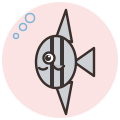
Elegance with fins.
Freshwater Angelfish
Pterophyllum scalare
Also called Angelfish, Angel, Scalare, Common angelfish
From South America: Amazon basin in Peru, Colombia and Brazil (Ucayali, Solimoes and Amazon rivers), plus rivers of Amapa (Brazil), the Oyapock in French Guiana and the Essequibo in Guyana123
At a glance the quick version
Looks how to spot one
Scaled cichlid with a very flat, disc-shaped body and long triangular fins
A tall, laterally flattened fish with a rounded body and long, swept-back dorsal and anal fins that give it a triangular or arrowhead outline, plus thin trailing pelvic fins. Wild-type fish are silvery with dark vertical bars that help them blend in among upright stems and roots. Captive breeding has produced many colour and fin forms, including veil-finned strains.43
Personality what they are like
A generally calm community cichlid that glides slowly through the water. Young fish often move around together, while adults form settled pairs and can become protective of a chosen spot, so an occasional squabble among angelfish is normal. They are natural predators of tiny fish, so very small tankmates may be seen as food.34
Daily activity how busy a day looks
Moderate. Angelfish prefer calm water with tall plants, roots or other vertical cover, and need enough tank height for their long fins.431
Grooming and care the hands-on bits
Tropical fish: keep water around 24 to 30 C, pH roughly 6.0 to 7.4 (FishBase allows up to 8.0) and soft to moderately hard water (about 0 to 15 dGH). Use steady filtration with gentle flow and regular partial water changes to keep conditions stable.312
Home where they are happiest
A tall aquarium of at least about 100 x 40 x 50 cm (around 200 litres) for a small group, furnished with broad-leaved plants, driftwood or other upright decor that mimics their densely vegetated, flooded home waters. Flat vertical surfaces such as slate or large leaves double as spawning sites.312
Food basics what goes in the bowl
Omnivorous with a taste for small live foods. In the wild they eat insects, worms, small crustaceans and fish fry. In the aquarium, feed a quality flake or pellet and add frozen, freeze-dried or live foods such as bloodworm and brine shrimp.23
Company who they like around
Best kept in a small group or as a bonded pair. Good companions are peaceful fish too large to fit in an angelfish's mouth; small species such as tiny tetras may be eaten. Pairs are monogamous and share parenting duties.34
The story where it all began
The species was described scientifically in 1823 from Amazonian specimens. It lives in swampy, flooded areas thick with vegetation, where its flat shape and vertical stripes let it slip unseen between stems and roots. Angelfish were first brought into Europe in 1909, when a Hamburg importer shipped them to Germany. Aquarists in the United States were breeding them by the late 1920s and early 1930s, and decades of captive breeding since then have produced a long list of colour, pattern and long-fin strains. Today almost all angelfish in the hobby are captive bred, and in 2022 the species' genome was sequenced and assembled.2413
Fun facts for the dinner table
- 1
The genus name Pterophyllum comes from Greek words meaning 'winged leaf', a fitting description of its shape.4
- 2
Angelfish form monogamous pairs, and both parents fan their eggs with their pectoral fins to keep fresh water flowing over them.4
- 3
A single spawning can produce anywhere from about 100 to more than 1,200 eggs, depending on the female.4
- 4
They like to lay eggs on upright surfaces, such as a broad leaf, a piece of slate, a filter pipe or even the aquarium glass.3
- 5
The first angelfish imported into Europe arrived in Hamburg, Germany, in 1909.2
- 6
The freshwater angelfish genome was sequenced and assembled in 2022 by a high school student.2
- 7
Their dark vertical bars are camouflage, helping them vanish among the stems and roots of flooded forests.4
Recognised by the official bits
- IUCN Red List
- Assessed as Least Concern (2020)1
- Scientific description
- Described by Schultze in Lichtenstein, 1823; family Cichlidae2
The care rhythm Furry Diary remembers it for you
A typical home-care rhythm for a Freshwater Angelfish. It is our own starting plan, not a vet's advice, and you can change every line in the app.
- FeedingSmall amounts once or twice a dayevery day
- Temperature checkevery day
- Water changeAbout 25% of the waterevery week
- Water testevery week
- Glass cleanevery week
- Filter rinseRinse in old tank water, never tap waterevery month
You might also like
 Altum Angelfish
 Discus
Like what we are building? Buy us a coffee.
The breed atlas is free for everyone, with a source on every fact, and it will never show ads. If it helped you, a small tip keeps the research going. Any amount is lovely, and no is a perfectly fine answer too.
Where this comes from
Every breed page shows where each fact comes from. If we got something wrong, sorry, we are pet people, not a science magazine. Tell us at [email protected] and we will fix it.
- Pterophyllum scalare - FishBase fishbase.seused for distribution, length, water parameters, habitat, IUCN status, breeding
- Pterophyllum scalare - Wikipedia en.wikipedia.orgused for taxonomy, distribution, diet, first import to Europe, genome fact
- Pterophyllum scalare - Seriously Fish seriouslyfish.comused for length, tank size, water parameters, behaviour, compatibility, spawning, strains
- Pterophyllum - Wikipedia en.wikipedia.orgused for etymology, body shape, lifespan, breeding, captive colour varieties, US breeding history
Checked 2026-09-30. Text is written in our own words from these sources.