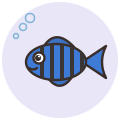
Not furry, but we like them anyway.
Johanni Cichlid
Melanochromis cyaneorhabdos Bowers & Stauffer, 1997; syn. Pseudotropheus cyaneorhabdos
Also called Maingano, Melanochromis 'maingano', Pseudotropheus cyaneorhabdos, Johanni (trade name)
From Endemic to Lake Malawi, East Africa: a single stretch of rocky shore on the northeast side of Likoma Island, at about 5-10 m depth.123
At a glance the quick version
Looks how to spot one
Slender, elongated mbuna
A slim mbuna in dark blue-black with bright light-blue horizontal stripes. Both sexes look much alike, and dominant males simply show the strongest colour.23
Personality what they are like
Lively and territorial; it fits in a mixed tank of other mbuna but not with peaceful species.3
Daily activity how busy a day looks
Grooming and care the hands-on bits
Hard, alkaline water with strong filtration and regular partial water changes; avoid mixing with other Melanochromis so lines stay true.3
Home where they are happiest
Aquarium with a base of at least about 90 x 45 cm (around 154 litres), stacked rocks, temperature 24-28 C, pH 7.6-8.8, hardness about 10-25 dGH.3
Food basics what goes in the bowl
In the wild it eats zooplankton and small invertebrates from the rocks. In aquariums it takes most foods; include plenty of vegetable food such as spirulina, plus live or frozen foods.13
Company who they like around
Keep one male with three or more females in a fairly well-stocked mbuna tank.3
The story where it all began
For years it was known in the hobby as Melanochromis 'maingano', after a village on the lake shore, and often sold as a johanni. Bowers and Stauffer described it formally in 1997 as M. cyaneorhabdos.32
Fun facts for the dinner table
- 1
Its striped pattern has been used by scientists to study how genes control colour patterns in fish.2
- 2
Unlike the true johanni, males and females look almost identical, which makes sexing tricky.3
- 3
Its whole wild range is one short stretch of shoreline at Likoma Island.3
- 4
The fry can eat baby brine shrimp as soon as they leave their mother's mouth.3
Recognised by the official bits
- IUCN Red List
- Critically Endangered (assessed 21 May 2018)1
- Taxonomy
- Described by Bowers & Stauffer in 1997; often confused with Melanochromis (Pseudotropheus) johannii, which is also sold as 'Johanni'2
The care rhythm Furry Diary remembers it for you
A typical home-care rhythm for a Johanni Cichlid. It is our own starting plan, not a vet's advice, and you can change every line in the app.
- FeedingSmall amounts once or twice a dayevery day
- Temperature checkevery day
- Water changeAbout 25% of the waterevery week
- Water testevery week
- Glass cleanevery week
- Filter rinseRinse in old tank water, never tap waterevery month
You might also like
 Auratus Cichlid
 Cobalt Blue Zebra Cichlid
 Saulosi Cichlid
Like what we are building? Buy us a coffee.
The breed atlas is free for everyone, with a source on every fact, and it will never show ads. If it helped you, a small tip keeps the research going. Any amount is lovely, and no is a perfectly fine answer too.
Where this comes from
Every breed page shows where each fact comes from. If we got something wrong, sorry, we are pet people, not a science magazine. Tell us at [email protected] and we will fix it.
- FishBase: Melanochromis (Pseudotropheus) cyaneorhabdos fishbase.seused for taxonomy, size, distribution, IUCN, diet
- Wikipedia: Melanochromis cyaneorhabdos en.wikipedia.orgused for names, colouring, taxonomy, fun facts
- Seriously Fish: Melanochromis cyaneorhabdos seriouslyfish.comused for care, water, diet, behaviour, breeding, history
Checked 2026-09-30. Text is written in our own words from these sources.