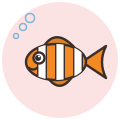
Not furry, but we like them anyway.
Ocellaris Clownfish
Amphiprion ocellaris
Also called False percula clownfish, Common clownfish, Clown anemonefish, False clown anemonefish, Western clown anemonefish
From Tropical Indo-West Pacific: from the Ryukyu Islands of Japan and Taiwan through Southeast Asia (Thailand, Malaysia, Singapore, Indonesia, the Philippines) and the eastern Indian Ocean to northwest Australia123
At a glance the quick version
Looks how to spot one
Small, rounded reef fish with a slimy protective coat
A compact, oval-bodied fish in bright orange with three white bands across the head, middle and tail base. Each white band and every fin edge is trimmed with a thin black line. A protective layer of mucus covers the body and lets it live among anemone tentacles. It has a slightly taller dorsal fin than its close look-alike, the percula clownfish.3247
Personality what they are like
Calm by clownfish standards, but it does claim a home spot and defends it. Groups follow a clear pecking order with one large female, one breeding male and smaller non-breeding fish below them. Wild fish rarely stray more than about 30 cm from their anemone.635
Daily activity how busy a day looks
A short-range swimmer that stays close to a chosen home base, such as an anemone, coral or rock, and wiggles in and out of it through the day rather than patrolling the whole tank.53
Grooming and care the hands-on bits
A fully marine fish kept at normal sea-water salinity (about 35 parts per thousand). It is described as easy to keep and adaptable. Stable, clean reef-style water conditions suit it, and an anemone is not required in captivity.367
Home where they are happiest
A saltwater aquarium with rockwork or a host to settle into. In the wild it lives on coastal reefs and in calm, sheltered lagoons at roughly 1 to 15 m depth, nestled in one of three large sea anemone species. In aquariums it will also adopt other anemones, corals or simply a favourite spot.1537
Food basics what goes in the bowl
An omnivore. In nature it eats zooplankton, copepods, small crustaceans and algae, plus scraps left over from its anemone's meals. In aquariums it takes a wide variety of marine flakes, pellets and frozen foods.3246
Company who they like around
Usually kept as a single fish or as a bonded pair. Two young fish placed together will sort out roles, with the larger one becoming the female. It is less tolerant of other clownfish with the same banding pattern.1376
The story where it all began
Georges Cuvier described the species in 1830. In the wild it lives in partnership with large sea anemones across the warm reefs of the Indo-Pacific. It was one of the first marine aquarium fish bred successfully in captivity, and that early success helped launch commercial breeding of ornamental marine fish; farms such as those in Florida now raise it in large numbers. Between 1997 and 2002 it ranked among the most traded marine fish, and in 2011 it made up almost half of all clownfish imported into the United States. Its fame grew further after the 2003 film Finding Nemo, whose main characters are ocellaris clownfish. Captive breeders have since developed many 'designer' colour and pattern forms.3617
Fun facts for the dinner table
- 1
All ocellaris clownfish start life as males. If the female of a group is lost, the dominant male changes sex and takes her place.2
- 2
Nemo and his father Marlin from Finding Nemo are ocellaris clownfish.3
- 3
Clownfish communicate with clicks, pops, grunts and chirps made by snapping their jaws, with the swim bladder amplifying the sound.7
- 4
A special mucus coat lets the clownfish live safely among stinging anemone tentacles; a newcomer gets used to its host by gently touching the tentacles with its belly and fins.4
- 5
Young clownfish find their way back to the right kind of anemone by smell, using a scent memory formed while they were still eggs.5
- 6
Spawning often happens around the full moon, and the father guards and fans the eggs until they hatch about a week later.4
- 7
A clownfish group lined up by rank is known as a queue.3
- 8
Studies show these fish can tell apart other clownfish by counting their white bars.7
Recognised by the official bits
- IUCN Red List
- Assessed as Least Concern (February 2021)1
- Georges Cuvier
- Species scientifically described by Cuvier in 18303
Popularity Ranked among the most traded marine aquarium fish in 1997 to 2002; in 2011 made up nearly half of all clownfish imported into the USA
The care rhythm Furry Diary remembers it for you
A typical home-care rhythm for a Ocellaris Clownfish. It is our own starting plan, not a vet's advice, and you can change every line in the app.
- FeedingSmall amounts once or twice a dayevery day
- Temperature checkevery day
- Salinity checkevery week
- Top-upTop up evaporation with fresh RO water, not salt waterevery day
- Water testevery week
- Water changeAbout 10 to 20% of the waterevery 2 weeks
- Glass cleanevery week
You might also like
 Percula Clownfish
 Tomato Clownfish
 Maroon Clownfish
 Pink Skunk Clownfish
 Clark's Clownfish
Like what we are building? Buy us a coffee.
The breed atlas is free for everyone, with a source on every fact, and it will never show ads. If it helped you, a small tip keeps the research going. Any amount is lovely, and no is a perfectly fine answer too.
Where this comes from
Every breed page shows where each fact comes from. If we got something wrong, sorry, we are pet people, not a science magazine. Tell us at [email protected] and we will fix it.
- FishBase: Amphiprion ocellaris, Clown anemonefish fishbase.seused for size, range, depth, host anemones, reproduction, IUCN status, captive breeding, longevity
- Florida Museum of Natural History: Clown Anemonefish floridamuseum.ufl.eduused for lifespan, colours, range, diet, sex change
- Wikipedia: Ocellaris clownfish en.wikipedia.orgused for names, colours, black form, salinity, social hierarchy, Finding Nemo, Cuvier 1830, dorsal fin, fun facts
- Animal Diversity Web (University of Michigan): Amphiprion ocellaris animaldiversity.orgused for lifespan, size, mucus coat, spawning, diet
- Aquarium of the Pacific: Clown Anemonefish aquariumofpacific.orgused for lifespan in wild and in care, habitat depth, territory, scent imprinting
- ORA (Oceans, Reefs and Aquariums): Ocellaris Clownfish orafarm.comused for captive breeding history, colour varieties, temperament, ease of care
- Wikipedia: Amphiprioninae en.wikipedia.orgused for trade statistics, designer morphs, sound production, bar recognition, aquarium keeping without anemones
Checked 2026-09-30. Text is written in our own words from these sources.