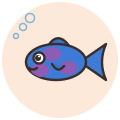
At a glance the quick version
Looks how to spot one
Single-tailed goldfish with nacreous (calico) scales
A streamlined goldfish with a single tail and evenly developed fins. Its scales are nacreous, a halfway stage between shiny metallic and clear scales, which gives a soft pearly sheen over a patchwork of colours. The London type has a sturdy body with short, rounded fins much like a common goldfish; the American type is slimmer with a long, deeply forked comet-style tail; the Bristol type has a slim body and a large, rounded, heart-shaped tail.142
Personality what they are like
Lively, peaceful and sociable. Shubunkins are quick, confident swimmers that do well with other single-tailed goldfish and similarly sized calm fish. Their speed means they can outcompete slow fancy goldfish at feeding time, so they are best kept with fish that match their pace.31
Daily activity how busy a day looks
High for a goldfish. An energetic swimmer that needs plenty of open length to swim, which is why a large aquarium or a garden pond suits it best.31
Grooming and care the hands-on bits
Needs strong filtration, weekly partial water changes (about 30%) with dechlorinated water and regular water tests for ammonia and nitrite. Feed small amounts that are finished within two to three minutes. Colour develops gradually: young fish take several months before their nacreous pattern shows fully.531
Home where they are happiest
A coldwater fish that prefers cooler water of about 15-21 °C (60-70 °F) and a pH of roughly 6.0-8.4 depending on source. In an aquarium allow at least about 75 litres (20 US gallons) per fish; a well-kept outdoor pond is an excellent long-term home. In the UK they thrive unheated in slightly alkaline, medium-hard water.36215
Food basics what goes in the bowl
Omnivore. A quality goldfish flake or pellet once or twice daily, plus vegetables such as blanched peas and occasional frozen or live treats like bloodworm. In ponds they also graze on plant material, small invertebrates and detritus.376
Company who they like around
A shoaling fish that should live in a group; FishBase recommends five or more goldfish together. Pairs well with comets, common goldfish and other active single-tailed varieties.63
The story where it all began
The shubunkin was created in Japan by crossing calico telescope-eyed goldfish with common single-tailed goldfish (wakin) and comet types. Sources date the first crosses to 1892 or around 1900, and the breeder is named as Akiyama. The name was given in 1900 by Japan's Fisheries Educational Institution under the Ministry of Agriculture and Commerce, and the fish was shown to the public in 1902. Once exported, it was shaped into regional types: the sturdy, short-finned London type; the comet-tailed American type, which became the most common worldwide; and the Bristol type, developed by the Bristol Aquarists' Society, which wrote the first Bristol Shubunkin standard in 1934 and adopted a modern standard in 1979 after about fifty years of selective breeding. British fishkeepers took to the shubunkin early as an ideal hardy, colourful coldwater fish.12
Fun facts for the dinner table
- 1
Blue is the most valued shubunkin colour, and it is produced by black pigment sitting deeper in the body wall beneath the scales.1
- 2
Shubunkin fry are not born with their calico look; the nacreous pattern takes several months to develop.1
- 3
The Bristol Shubunkin standard requires at least a quarter of the body to be blue.2
- 4
The Bristol type is the rarest of the three shubunkin types, while the American type is the most common.1
- 5
Thanks to their koi-like colours, American shubunkins are sometimes nicknamed 'poor man's koi'.1
- 6
The name 'shubunkin' was officially given in 1900 by a Japanese government fisheries institute, and the fish made its public debut in 1902.2
- 7
Nacreous scales appear when a goldfish inherits both the metallic and the transparent (matte) scale genes.1
Recognised by the official bits
- Bristol Aquarists' Society / goldfish-types.info
- Bristol Shubunkin show standard first written in 1934, revised in 1938 and replaced by a modern standard in 1979: body about 35% as deep as long, single broad tail with rounded lobes, minimum body length 7.5 cm, at least 25% of the body blue2
- Show standards (general)
- Only nacreous (calico) scales are accepted under shubunkin standards; recognised types are London, Bristol and American1
- IUCN Red List
- The species Carassius auratus is assessed as Least Concern6
- Taxonomy
- Single-tailed domestic variety of the goldfish, family Cyprinidae4
The care rhythm Furry Diary remembers it for you
A typical home-care rhythm for a Shubunkin. It is our own starting plan, not a vet's advice, and you can change every line in the app.
- Feedingevery day
- Water changeAbout 25 to 30% of the waterevery week
- Water testevery week
- Glass cleanevery week
- Filter rinseevery month
You might also like
 Comet Goldfish
 Common Goldfish
 Wakin
Wakin Koi
Koi Fantail Goldfish
Like what we are building? Buy us a coffee.
The breed atlas is free for everyone, with a source on every fact, and it will never show ads. If it helped you, a small tip keeps the research going. Any amount is lovely, and no is a perfectly fine answer too.
Where this comes from
Every breed page shows where each fact comes from. If we got something wrong, sorry, we are pet people, not a science magazine. Tell us at [email protected] and we will fix it.
- Shubunkin - Wikipedia en.wikipedia.orgused for origin, history, types, size, lifespan, colours, nacreous scale genetics, fun facts
- Bristol Shubunkin - goldfish-types.info goldfish-types.infoused for history dates, naming, BAS standard 1934/1938/1979, colour requirements, hardiness, water conditions
- Goldfish Care Sheet - Aqueon aqueon.comused for shubunkin temperature, tank size, pond suitability, diet, tankmates
- List of goldfish varieties - Wikipedia en.wikipedia.orgused for London/American/Bristol body and fin descriptions
- Fish environment - RSPCA rspca.org.ukused for filtration, water changes, temperature
- Carassius auratus - FishBase fishbase.seused for pH, wild diet, group size, IUCN status
- Goldfish - Wikipedia en.wikipedia.orgused for diet supplements
- Bristol Aquarists' Society bristol-aquarists.org.ukused for notes the society closed in Dec 2024 with goldfish-types.info as successor site
Checked 2026-09-30. Text is written in our own words from these sources.