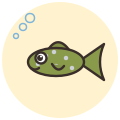
Not furry, but we like them anyway.
Splash Tetra
Copella arnoldi
Also called Splashing tetra, Spraying tetra, Jumping tetra
From Northern South America: the lower Amazon basin and coastal rivers of Brazil, Guyana, Suriname, French Guiana and eastern Venezuela, including the Orinoco mouth.123
At a glance the quick version
Looks how to spot one
Slender surface-dwelling characin
A slim, light-coloured fish with an upturned mouth made for snapping food from the surface. A dark line runs from the snout to the eye and there is a dark spot on the dorsal fin. It has no adipose fin. Males are larger with longer fins and silvery-white patches on some flank scales.32
Personality what they are like
A peaceful fish that lives near the surface. It is a little specialised for a busy community tank and does best with calm companions of a similar size.2
Daily activity how busy a day looks
Active near the surface and an accomplished jumper, so a well-fitted lid is needed.2
Grooming and care the hands-on bits
Keep water clean and stable; leave a gap between the water and the lid with overhanging leaves or decor if you would like to see natural spawning.2
Home where they are happiest
A tank with a footprint of at least 90 x 30 cm, with floating plants and a tight cover. Water 20-28 C (FishBase: 25-29 C), pH about 4.0-7.5 (FishBase: 6.0-8.0), soft to medium hardness.21
Food basics what goes in the bowl
A micropredator. Feeds on small insects falling onto the water, worms and tiny crustaceans. Offer fine dry foods plus daily small live or frozen foods such as baby brine shrimp and grindal worms.23
Company who they like around
Keep a group of at least 8-10. Suitable tankmates are similar-sized tetras, small catfish and non-predatory cichlids.2
The story where it all began
Charles Tate Regan described the splash tetra in 1912 and named it after Johann Paul Arnold, a German aquarist who collected the first specimen. Its remarkable habit of laying eggs above the water has made it a classic subject in aquarium and behaviour studies.31
Fun facts for the dinner table
- 1
A pair leaps out of the water together and clings to an overhanging leaf for up to about ten seconds while laying and fertilising eggs.3
- 2
The male then keeps the eggs moist by flicking water onto them with his tail, sometimes dozens of times an hour, until they hatch.3
- 3
Eggs hatch in about 36-72 hours and the larvae drop into the water below.2
- 4
Unlike most tetras it has no adipose fin.3
Recognised by the official bits
- IUCN Red List
- Assessed as Least Concern (September 2020)1
The care rhythm Furry Diary remembers it for you
A typical home-care rhythm for a Splash Tetra. It is our own starting plan, not a vet's advice, and you can change every line in the app.
- FeedingSmall amounts once or twice a dayevery day
- Temperature checkevery day
- Water changeAbout 25% of the waterevery week
- Water testevery week
- Glass cleanevery week
- Filter rinseRinse in old tank water, never tap waterevery month
You might also like
 Marbled Hatchetfish
 Common Hatchetfish
Like what we are building? Buy us a coffee.
The breed atlas is free for everyone, with a source on every fact, and it will never show ads. If it helped you, a small tip keeps the research going. Any amount is lovely, and no is a perfectly fine answer too.
Where this comes from
Every breed page shows where each fact comes from. If we got something wrong, sorry, we are pet people, not a science magazine. Tell us at [email protected] and we will fix it.
- Copella arnoldi, FishBase fishbase.seused for distribution, max length, water parameters, IUCN status, spawning, author
- Copella arnoldi, Seriously Fish seriouslyfish.comused for other names, origin, size, tank and water parameters, diet, behaviour, spawning
- Splash tetra, Wikipedia en.wikipedia.orgused for appearance, history and naming, spawning details, diet
Checked 2026-09-30. Text is written in our own words from these sources.