Monk Parakeet
Myiopsitta monachus
Also called Quaker parrot, Quaker parakeet, Monk parrot, Grey-breasted parakeet
From Temperate and subtropical South America: Argentina, Uruguay, Paraguay, Bolivia and southern Brazil. It favours dry open country with scattered trees, gallery forest, Chaco savanna, palm groves and eucalyptus plantations up to about 1,000 m, and readily settles in towns. Free-living populations descended from pet birds now also live in parts of North America, Europe, the Middle East and East Asia.123
At a glance the quick version
Looks how to spot one
Feathered; stocky medium parakeet with a long, tapering tail
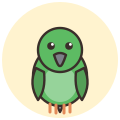
A sturdy, bright green parakeet with a soft pale grey forehead, face and chest, the chest feathers edged darker so they look scalloped. The belly shades from light green to yellowish, the flight feathers are deep blue and the long tail narrows to a point. The beak is orange-toned. Males and females look alike, with females a little smaller.124
Personality what they are like
Quakers are sociable, clever and full of chatter. A hand-raised bird can become as tame and cuddly as any companion parrot, and it loves being included in family life. Many start talking early and go on to learn dozens of words and phrases, which is remarkable for a bird of this size. They are also naturally loud, with calls that carry well, so they suit households where a lively voice is welcome. A charming quirk is their habit of bobbing and quivering, which is one of the stories behind the name Quaker.41
Daily activity how busy a day looks
Moderate to high. It enjoys daily out-of-cage time with its people, trick training rewarded with treats or praise, and a steady supply of things to chew, shred and build with.4
Grooming and care the hands-on bits
An enthusiastic chewer, so keep it supplied with safe chew toys and natural branches, which also help keep beak and nails in trim. Offer a shallow dish or light spray for bathing. Being a natural builder, it often likes to arrange nesting material and can become protective of its cage, so a calm routine around the cage helps.41
Home where they are happiest
A sturdy, roomy parrot cage with several perches, plenty of chewable toys and safe branches, and space for daily supervised time out. It copes with a wider temperature range than most parrots, since it is one of the few temperate-zone species. Check local laws first, as ownership is restricted in some places.413
Food basics what goes in the bowl
Wild birds eat seeds (especially thistle and grass seeds), fruit, nuts, blossoms, leaf buds and occasionally insects. At home a pelleted base plus fresh vegetables, fruit and healthy table foods makes a balanced diet.234
Company who they like around
Highly social; in the wild it lives in flocks and shares huge colony nests. As a pet it needs regular company from its family or another Quaker and does not do well when left alone for long stretches.43
The story where it all began
The French naturalist Buffon described the monk parakeet in 1780, and Pieter Boddaert gave it the scientific name Psittacus monachus in 1783, later moved by Bonaparte to its own genus, Myiopsitta, in 1854. The genus name joins the Greek word for mouse with the word for parrot, a nod to its mouse-grey face and chest, while 'monk' and 'Quaker' both refer to that sober grey 'hood'. Between the 1960s and 1980s thousands were exported from South America to the United States as pets. Some escaped or were released, and by the early 1970s small free-living colonies had formed in several states, with Chicago's first known nest recorded in 1973. Similar colonies grew in Europe, especially in Spain, so today this South American bird is a familiar sight in cities such as Barcelona, Madrid, Brooklyn and Chicago. At the same time its talent for speech and its friendly nature made it one of the best known medium-sized pet parrots.14
Fun facts for the dinner table
- 1
It is the only parrot (together with its close relative the cliff parakeet) that builds its own large stick nests out in the open instead of nesting in a hole.1
- 2
Colony nests can grow to the size of a car, with a separate entrance and apartment for each pair, and the birds sleep in them all year round.1
- 3
Inside a nest, chambers can serve different roles, such as incubating eggs, raising chicks or keeping watch.3
- 4
Other animals, including pigeons, sparrows, American kestrels and even squirrels, sometimes move into spare rooms in monk parakeet nests.1
- 5
It is one of the few parrots at home in cold climates; a colony near Montreal, started by six birds released from a pet shop in 1984, bred there in 1987.1
- 6
New York's monk parakeets live in Brooklyn and Queens but not Manhattan, which has its power lines underground and so lacks their favourite nesting poles.1
- 7
Individual birds may have their own recognisable 'voice print', which could help flock mates tell each other apart.1
- 8
Madrid's free-living population reached about 10,800 birds in June 2015.1
Recognised by the official bits
- IUCN Red List
- Least Concern, with a population described as unknown but increasing.2
- CITES
- Listed on Appendix II.2
- Taxonomy
- First described by Buffon in 1780 and given the name Psittacus monachus by Pieter Boddaert in 1783; moved to the genus Myiopsitta by Charles Lucien Bonaparte in 1854. Three subspecies are recognised (monachus, calita and cotorra). The cliff parakeet of the Andean foothills was split off as a separate species in 2015.1
- Legal note (USA)
- Keeping monk parakeets is banned or restricted in a number of US states, so owners should check local rules before buying one.1
The care rhythm Furry Diary remembers it for you
A typical home-care rhythm for a Monk Parakeet. It is our own starting plan, not a vet's advice, and you can change every line in the app.
- Fresh food and waterevery day
- Cage linerevery 2 days
- Full cleanevery week
- Bath offerevery 3 days
- Nails checkevery month
- Beak checkevery month
- Toy rotationevery week
- Out-of-cage timeAbout 2 hours a dayevery day
- Vet check-upevery year
You might also like
 Green-cheeked Conure
 Indian Ringneck Parakeet
 Sun Conure
 Cockatiel
Like what we are building? Buy Archy a bone.
All of this is free for everyone, with a source on every fact, and it will never show ads. It was a big job to build, so if it helped you, buy Archy a bone. Any amount is lovely, and no is a perfectly fine answer too.
Archy is our Australian Cattle Dog and chief taste tester. Tips go to 4V3D OÜ, the small family studio behind Furry Diary.
Where this comes from
Every breed page shows where each fact comes from. If we got something wrong, sorry, we are pet people, not a science magazine. Tell us at [email protected] and we will fix it.
- Monk parakeet - Wikipedia en.wikipedia.orgused for Size, weight, range, taxonomy, etymology, history of pet trade and feral colonies, nests, colours, legal notes, fun facts
- Monk Parakeet - World Parrot Trust Parrot Encyclopedia parrots.orgused for Length, weight, lifespan, subspecies ranges, habitat, wild diet, IUCN and CITES status
- Myiopsitta monachus - Animal Diversity Web (University of Michigan) animaldiversity.orgused for Mass, length, diet, nest chambers, cold tolerance, social behaviour
- Quaker Parakeet Personality, Food & Care - Lafeber lafeber.comused for Temperament, talking, noise, care, diet, colour mutations, lifespan, Quaker name
Checked 2026-09-30. Text is written in our own words from these sources.