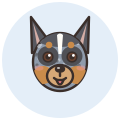
At a glance the quick version
Coat and looks how to spot one
short dense double coat
A square, leggy working dog with small pricked ears and a naturally short tail no longer than about 10 cm. The outer coat is fairly short, straight and harsh over a soft undercoat, with a slight ruff at the neck.123
Personality what they are like
A keen, courageous herding dog that bonds closely with its owner and responds well to them. It keeps a careful eye on its surroundings and tends to stay aloof with people it does not know.12
Daily activity how busy a day looks
High energy with a real need for work or mental challenge. Stumpies do well in herding, agility, obedience, flyball, tracking and frisbee.2
Grooming and care the hands-on bits
The short weather-resistant coat needs only routine brushing.1
Company who they like around
Very people-focused with its own family; early socialisation helps with its natural reserve towards strangers.12
The story where it all began
Its roots lie in 19th-century Australia, where drovers crossed imported working dogs such as the Smithfield with Dingoes to make hardy cattle dogs. Tailless and long-tailed types slowly separated, and the ANKC issued a standard for the stumpy-tailed dog in 1963. A breeding development programme in the 1980s helped keep the breed going, and FCI acceptance followed in the early 2000s.12
Fun facts for the dinner table
- 1
It is not an Australian Cattle Dog with a docked tail: the short tail is natural.3
- 2
The FCI standard credits the Smithfield for the bobbed tail and the Dingo for the red colouring.1
- 3
Early versions were known as Halls Heelers or Timmins Biters, after the men linked to their development.1
- 4
Owners commonly call the breed simply the Stumpy.2
Recognised by the official bits
- FCI
- Standard no. 351, Group 1, Section 2 Cattledogs; definitive recognition, standard published 06.07.2005 (accepted by FCI in 2003 per Wikipedia).1
- ANKC
- Official standard issued in 1963; current name adopted in 2001.2
- AKC
- Listed by the AKC with a breed page describing it as a naturally bob-tailed breed.3
The care rhythm Furry Diary remembers it for you
A typical home-care rhythm for a Australian Stumpy Tail Cattle Dog. It is our own starting plan, not a vet's advice, and you can change every line in the app.
- BrushingDaily during heavy sheddingevery 3 days
- Double coats insulate against cold and heat, so shaving is not recommended
- Bathevery 10 weeks
- Nail trimSooner if you hear clicking on the floorevery month
- Ear checkevery 2 weeks
- Teeth brushingDaily brushing is idealevery 2 days
- ExerciseDaily walks and playevery day
- Flea, tick and worm protectionSchedule as your vet recommendsas your vet recommends
- Vet check-upSenior years usually start around age 8every year
You might also like
 Australian Cattle Dog
 Australian Kelpie
 Koolie
Like what we are building? Buy us a coffee.
The breed atlas is free for everyone, with a source on every fact, and it will never show ads. If it helped you, a small tip keeps the research going. Any amount is lovely, and no is a perfectly fine answer too.
Where this comes from
Every breed page shows where each fact comes from. If we got something wrong, sorry, we are pet people, not a science magazine. Tell us at [email protected] and we will fix it.
- FCI Standard No. 351 Australian Stumpy Tail Cattle Dog fci.beused for recognition, history, height, coat, colours, temperament
- Wikipedia: Australian Stumpy Tail Cattle Dog en.wikipedia.orgused for history, recognition dates, activities, nickname
- AKC: Australian Stumpy Tail Cattle Dog akc.orgused for natural bob tail
Checked 2026-09-30. Text is written in our own words from these sources.