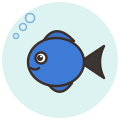
Not furry, but we like them anyway.
Achilles Tang
Acanthurus achilles Shaw, 1803
Also called Redtail surgeonfish, Redspot surgeonfish, Paku'iku'i (Hawaiian)
From Oceanic islands of the Pacific, including Hawaii, Polynesia, Micronesia, the Pitcairn, Wake, Marcus and Mariana islands, with records off southern Mexico and Baja California.123
At a glance the quick version
Maximum total length.
Looks how to spot one
Scaled, oval surgeonfish
An oval, deep-bodied tang with a steep forehead and a slightly extended snout. The body is a velvety blue-black, set off by a bold orange teardrop patch around the tail spine, an orange tail with a white trailing edge, a pale blue ring around the chin and a white mark on the gill cover. Juveniles lack the orange patch, which appears as they grow.213
Personality what they are like
Bold and lively. It defends its favourite feeding spots and will chase other surgeonfish away, so it is best kept as the only one of its kind with peaceful, robust companions.32
Daily activity how busy a day looks
Very active during the day in fast-moving, surging water, constantly grazing rocks. It needs lots of swimming room and vigorous water flow.31
Grooming and care the hands-on bits
Marine reef fish for a mature saltwater aquarium. Typical reef-tank conditions are 24-27 C, salinity 1.022-1.025 specific gravity and pH around 8.2, matching the warm tropical reefs it comes from. Keep water quality stable and offer algae-based meals every day. The blade-like tail spines are sharp, so move it with a net or container rather than bare hands. Strong, well-oxygenated water movement echoes the surge zones it comes from.413
Home where they are happiest
Lives on clear outer reefs and rocky shores in surge zones, usually in the top 4 m and down to about 10 m. A large reef aquarium with powerful water movement and grazing rock suits it. No minimum tank volume from a primary source was found.13
Food basics what goes in the bowl
A herbivore that grazes filamentous and small fleshy algae using flexible, comb-like teeth. Offer mostly marine algae and seaweed foods.13
Company who they like around
Often found in groups on the reef, yet territorial around food; forms monogamous pairs.123
The story where it all began
English biologist George Shaw described the species in 1803, likely naming it after the Greek hero Achilles. In Hawaii its tail blades were traditionally built into fishing lures.23
Fun facts for the dinner table
- 1
Its Hawaiian name, paku'iku'i, relates to splashing or beating the water.3
- 2
The orange patch around its tail spine is thought to act as a warning sign to other fish.3
- 3
Juveniles have no orange spot; they transform at about 6 cm long.1
- 4
Hawaiians once used its tail blades in fishing lures.3
- 5
It sometimes hybridises with the whitecheek surgeonfish, Acanthurus nigricans.2
Recognised by the official bits
- IUCN Red List
- Least Concern (assessed 3 May 2010)1
- Taxonomy
- Family Acanthuridae; described by George Shaw in 18032
The care rhythm Furry Diary remembers it for you
A typical home-care rhythm for a Achilles Tang. It is our own starting plan, not a vet's advice, and you can change every line in the app.
- FeedingSmall amounts once or twice a dayevery day
- Temperature checkevery day
- Salinity checkevery week
- Top-upTop up evaporation with fresh RO water, not salt waterevery day
- Water testevery week
- Water changeAbout 10 to 20% of the waterevery 2 weeks
- Glass cleanevery week
You might also like
 Powder Blue Tang
 Powder Brown Tang
 Naso Tang
Like what we are building? Buy us a coffee.
The breed atlas is free for everyone, with a source on every fact, and it will never show ads. If it helped you, a small tip keeps the research going. Any amount is lovely, and no is a perfectly fine answer too.
Where this comes from
Every breed page shows where each fact comes from. If we got something wrong, sorry, we are pet people, not a science magazine. Tell us at [email protected] and we will fix it.
- FishBase: Acanthurus achilles summary fishbase.seused for distribution, depth, length, diet, IUCN status, colour, juvenile change
- Wikipedia: Achilles tang en.wikipedia.orgused for names, description, behaviour, taxonomy, hybridisation
- Waikiki Aquarium (University of Hawaii): Achilles Tang waikikiaquarium.orgused for Hawaiian name, habitat, diet, behaviour, cultural use, colour
- Wikipedia: Reef aquarium en.wikipedia.orgused for general reef aquarium water parameters
Checked 2026-09-30. Text is written in our own words from these sources.