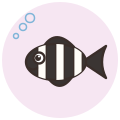
Not furry, but we like them anyway.
Black Ocellaris Clownfish
Amphiprion ocellaris
Also called Black Ocellaris, Darwin Ocellaris, Darwin False Percula
From A natural colour form of the ocellaris clownfish found only around Darwin in Northern Australia; almost all fish in the hobby are captive-bred12
At a glance the quick version
Looks how to spot one
Personality what they are like
Calm and peaceful for a clownfish, though it will claim and defend a favourite spot in the tank.42
Daily activity how busy a day looks
Stays close to a chosen home base such as an anemone, coral or rock and bobs in and out of it rather than roaming the whole tank.72
Grooming and care the hands-on bits
A fully marine fish. Suggested aquarium water: about 22 to 26 °C (72 to 78 °F), pH 8.1 to 8.4, carbonate hardness 8 to 12 dKH and specific gravity 1.020 to 1.025. Rated easy to care for, and it does not need an anemone to do well.4
Home where they are happiest
A saltwater reef or fish-only aquarium of at least about 76 L (20 US gallons), with rockwork or a host anemone or coral to settle into.42
Food basics what goes in the bowl
An omnivore that readily takes marine flakes, pellets and frozen meaty foods, with some algae-based food in the mix.42
Company who they like around
Best kept alone or as a bonded pair. Two young fish put together will settle into a pair, with the larger one becoming the female.23
The story where it all began
This black form occurs naturally only in a small area around Darwin, Northern Australia, so wild fish are hardly ever exported. Aquaculture breeders took it on, and today captive-bred fish supply nearly the entire hobby. Scientists have discussed whether it deserves species status, but it is still treated as a colour variety of the ocellaris clownfish.1
Fun facts for the dinner table
- 1
It is also called the Darwin Ocellaris after the Australian city near where the wild form lives.1
- 2
Babies hatch looking like ordinary orange clownfish and only turn black as they grow.1
- 3
Like all ocellaris clownfish, every fish starts life as a male, and the dominant one becomes female when the group needs one.5
- 4
Clownfish talk to each other with clicks and pops made by snapping their jaws.8
Recognised by the official bits
- IUCN Red List
- Parent species Amphiprion ocellaris assessed as Least Concern; the black form is treated as a colour variety, not a separate species3
- ORA (aquaculture breeder)
- Classed as a colour morph of A. ocellaris; its status as a possible separate species has been debated1
The care rhythm Furry Diary remembers it for you
A typical home-care rhythm for a Black Ocellaris Clownfish. It is our own starting plan, not a vet's advice, and you can change every line in the app.
- FeedingSmall amounts once or twice a dayevery day
- Temperature checkevery day
- Salinity checkevery week
- Top-upTop up evaporation with fresh RO water, not salt waterevery day
- Water testevery week
- Water changeAbout 10 to 20% of the waterevery 2 weeks
- Glass cleanevery week
You might also like
 Ocellaris Clownfish
 Snowflake Clownfish
 Percula Clownfish
 Picasso Clownfish
Like what we are building? Buy us a coffee.
The breed atlas is free for everyone, with a source on every fact, and it will never show ads. If it helped you, a small tip keeps the research going. Any amount is lovely, and no is a perfectly fine answer too.
Where this comes from
Every breed page shows where each fact comes from. If we got something wrong, sorry, we are pet people, not a science magazine. Tell us at [email protected] and we will fix it.
- ORA (Oceans, Reefs and Aquariums): Black Ocellaris Clownfish orafarm.comused for origin, colour development, history, taxonomy note, names
- Wikipedia: Ocellaris clownfish en.wikipedia.orgused for wild black form in Northern Australia, pairing, diet
- FishBase: Amphiprion ocellaris fishbase.seused for size, IUCN status of parent species
- LiveAquaria: Ocellaris Clownfish quick stats liveaquaria.comused for care level, temperament, max size, tank size, water parameters, diet
- Florida Museum of Natural History: Clown Anemonefish floridamuseum.ufl.eduused for lifespan, sex change
- Animal Diversity Web (University of Michigan): Amphiprion ocellaris animaldiversity.orgused for lifespan
- Aquarium of the Pacific: Clown Anemonefish aquariumofpacific.orgused for lifespan, home-base behaviour
- Wikipedia: Amphiprioninae en.wikipedia.orgused for sound production
Checked 2026-09-30. Text is written in our own words from these sources.