At a glance the quick version
Looks how to spot one
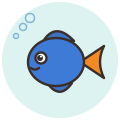
Very small, deep-bodied dwarf angelfish
One of the smallest angelfish. The oval body is deep sapphire blue, while the face and chest are orange-yellow with a thin blue ring around the eye. The fins are blue with paler blue edges, and there is a sturdy spine at the corner of the gill cover.23
Personality what they are like
Semi-aggressive for its size and best kept one per tank, though a mated pair can live together. It ducks into holes when startled.31
Daily activity how busy a day looks
An active little grazer that stays close to rubble and rock.13
Grooming and care the hands-on bits
Provide live rock and plenty of hiding places. It may nip at large-polyped stony corals and clam mantles.3
Home where they are happiest
A tank of at least 50 to 55 US gallons (about 190 to 210 L) with live rock. Saltwater at about 22 to 26 °C, pH 8.1 to 8.4, dKH 8 to 12, specific gravity 1.020 to 1.025. In the wild it lives over coral rubble, mostly at about 5 to 30 m.31
Food basics what goes in the bowl
An omnivore. Offer a varied menu of spirulina and marine algae, a good angelfish food, and meaty items such as frozen mysis shrimp. Feed small portions about three times a day. Wild fish eat algae and small bottom-living invertebrates.312
Company who they like around
Lives in small groups with one male, a few females and juveniles. A single fish or a mated pair suits most home tanks.213
The story where it all began
Loren P. Woods and Robert H. Kanazawa described the species in 1951. The name argi comes from Argus Bank near Bermuda, where the type specimens were found.21
Fun facts for the dinner table
Recognised by the official bits
- IUCN Red List
- Least Concern (assessed 2009)1
The care rhythm Furry Diary remembers it for you
A typical home-care rhythm for a Cherub Angelfish. It is our own starting plan, not a vet's advice, and you can change every line in the app.
- FeedingSmall amounts once or twice a dayevery day
- Temperature checkevery day
- Salinity checkevery week
- Top-upTop up evaporation with fresh RO water, not salt waterevery day
- Water testevery week
- Water changeAbout 10 to 20% of the waterevery 2 weeks
- Glass cleanevery week
You might also like
 Coral Beauty
 Flame Angelfish
 Bicolor Angelfish
 Lemonpeel Angelfish
Like what we are building? Buy us a coffee.
The breed atlas is free for everyone, with a source on every fact, and it will never show ads. If it helped you, a small tip keeps the research going. Any amount is lovely, and no is a perfectly fine answer too.
Where this comes from
Every breed page shows where each fact comes from. If we got something wrong, sorry, we are pet people, not a science magazine. Tell us at [email protected] and we will fix it.
- FishBase: Centropyge argi, Cherubfish fishbase.seused for length, distribution, depth, habitat, diet, pairing, IUCN status, describer
- Wikipedia: Centropyge argi en.wikipedia.orgused for colour description, size, distribution, social groups, history, etymology
- LiveAquaria: Pygmy (Cherub) Angelfish liveaquaria.comused for aquarium care, tank size, water parameters, temperament, diet, captive breeding
Checked 2026-09-30. Text is written in our own words from these sources.