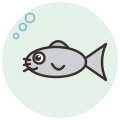
Not furry, but we like them anyway.
Columbian Shark Catfish
Ariopsis seemanni
Also called Colombian shark catfish, Tete sea catfish, Silver-tipped shark, White-tip shark catfish, Black fin shark
From Pacific coast of the Americas, in coastal seas, estuaries and Pacific-draining rivers; recorded from El Salvador to Panama, with a wider range from Mexico to Peru given by other sources123
At a glance the quick version
Looks how to spot one
Sleek, shark-shaped sea catfish
A streamlined catfish with a tall, pointed dorsal fin and forked tail that give it a shark-like look. Young fish are silvery with dark fins tipped in white, and adults become thicker-bodied, females more so than males. It can reach about 35 cm standard length and up to around 44 cm in total length.213
Personality what they are like
Peaceful and sociable towards its own species and comfortable in a small group. It is a lively, constantly moving fish.23
Daily activity how busy a day looks
A very active swimmer that needs long, open swimming space.32
Grooming and care the hands-on bits
Temperature about 22 to 26 °C and pH around 6.8 to 8.5. Juveniles manage in hard fresh water, but salt must be added as the fish grows, ending in brackish water around specific gravity 1.005 or full sea water for adults. The fin spines carry venom glands, so handle with care and use a net. Best suited to keepers who can provide a very large tank for life.213
Home where they are happiest
Coastal marine and brackish waters and medium to large rivers. Adults need a very large aquarium, with a base of at least about 240 x 60 cm (around 860 litres).12
Food basics what goes in the bowl
A meat eater. Young fish take bloodworm and other small meaty foods; larger fish take earthworms, mussel, prawn and sinking pellets or tablets.2
Company who they like around
Does best in a small group of its own kind.2
The story where it all began
Günther described the species in 1864 as Arius seemanni, and it has since been moved between several genera. It is fished commercially in its home range, appears in public aquariums and is sometimes sold as a young fish in the pet trade.31
Fun facts for the dinner table
- 1
Males carry the fertilised eggs in their mouths until they hatch.1
- 2
It can make audible sounds by grinding the bones of its pectoral fins.2
- 3
Young fish live in rivers and move to brackish and salt water as they grow up.3
- 4
It goes by an unusually long list of trade names, from 'silver-tipped shark' to 'Christian catfish'.3
Recognised by the official bits
- IUCN Red List
- Least Concern (assessed 2007)1
- Albert Günther
- Described in 1864 as Arius seemanni3
The care rhythm Furry Diary remembers it for you
A typical home-care rhythm for a Columbian Shark Catfish. It is our own starting plan, not a vet's advice, and you can change every line in the app.
- FeedingSmall amounts once or twice a dayevery day
- Temperature checkevery day
- Salinity checkevery week
- Top-upTop up evaporation with fresh RO water, not salt waterevery day
- Water testevery week
- Water changeAbout 10 to 20% of the waterevery 2 weeks
- Glass cleanevery week
You might also like
 Spotted Scat
 Four-eyed Fish
Like what we are building? Buy us a coffee.
The breed atlas is free for everyone, with a source on every fact, and it will never show ads. If it helped you, a small tip keeps the research going. Any amount is lovely, and no is a perfectly fine answer too.
Where this comes from
Every breed page shows where each fact comes from. If we got something wrong, sorry, we are pet people, not a science magazine. Tell us at [email protected] and we will fix it.
- FishBase: Ariopsis seemanni, Tete sea catfish fishbase.seused for range, size, weight, environment, water parameters, mouthbrooding, tank size, IUCN, author
- Seriously Fish: Ariopsis seemanni seriouslyfish.comused for size, tank size, water parameters, salinity by age, diet, group size, sounds, breeding
- Wikipedia: Ariopsis seemanni en.wikipedia.orgused for common names, range, salinity change with age, aquarium suitability, naming
Checked 2026-09-30. Text is written in our own words from these sources.