At a glance the quick version
Looks how to spot one
Long, slender surface-dwelling fish with raised, split eyes
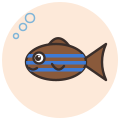
An elongated, brownish fish with a pale belly and usually three blue to purple stripes along the side. Its eyes sit high on the head and each one is divided into an upper and lower half, letting it see above and below the water at the same time. Females grow noticeably larger than males.21
Personality what they are like
A schooling fish that is usually calm with its own kind; squabbles are rare apart from heavily pregnant females.32
Daily activity how busy a day looks
Spends nearly all its time cruising at the surface, rarely diving. It is a strong jumper and will leap to catch insects.23
Grooming and care the hands-on bits
Warm brackish water around 25 to 31 °C, pH about 7.5 to 9.0 and specific gravity roughly 1.005 to 1.015. A tight-fitting lid is essential because of its powerful leap. Feeding twice a day mirrors its natural rhythm.31
Home where they are happiest
Estuaries, lagoons, mangrove coasts and mudflats. In an aquarium it needs a wide surface area rather than depth, with a base of about 150 x 45 cm and water around 15 cm deep, plus shallow or exposed areas to rest on and root-like branches imitating mangroves.123
Food basics what goes in the bowl
A generalist feeder. Wild fish eat insects, small invertebrates, small crabs and fish, algae and diatoms from the mud. In captivity it takes floating foods with spirulina, bloodworm, brine shrimp and earthworms.123
Company who they like around
A schooling species; wild groups hold 10 to 50 fish. Keep at least six, ideally a dozen or more, preferably in a species-only tank.23
The story where it all began
Linnaeus described the fish in 1758 under the genus Cobitis, and it was later placed in Anableps, from Greek words meaning 'looking up'. It is found in the aquarium trade and is also studied by scientists interested in its remarkable eyes.21
Fun facts for the dinner table
- 1
It does not really have four eyes: each eye is split into two halves with separate pupils for viewing above and below the waterline.2
- 2
Babies are born live and already measure about 4.5 to 5 cm.1
- 3
Males and females are 'left-handed' or 'right-handed', and a pair must be a matching combination to mate.2
- 4
It can stay on exposed mud at low tide and sometimes hops onto mudbanks to feed.1
Recognised by the official bits
- IUCN Red List
- Least Concern (assessed 2020)1
- Carl Linnaeus
- Described in 1758 in Systema Naturae, first placed in the genus Cobitis2
The care rhythm Furry Diary remembers it for you
A typical home-care rhythm for a Four-eyed Fish. It is our own starting plan, not a vet's advice, and you can change every line in the app.
- FeedingSmall amounts once or twice a dayevery day
- Temperature checkevery day
- Salinity checkBrackish fish need a little marine salt, and some need more as they growevery week
- Water changeAbout 25% of the water, mixed to the same salinityevery week
- Water testevery week
- Filter rinseRinse in old tank water, never tap waterevery month
You might also like
 Spotted Scat
 Columbian Shark Catfish
Like what we are building? Buy us a coffee.
The breed atlas is free for everyone, with a source on every fact, and it will never show ads. If it helped you, a small tip keeps the research going. Any amount is lovely, and no is a perfectly fine answer too.
Where this comes from
Every breed page shows where each fact comes from. If we got something wrong, sorry, we are pet people, not a science magazine. Tell us at [email protected] and we will fix it.
- FishBase: Anableps anableps, Largescale foureyes fishbase.seused for range, size, environment, temperature, diet, live-bearing, IUCN, author
- Wikipedia: Anableps anableps en.wikipedia.orgused for names, eye structure, colours, size and weight, behaviour, schooling, reproduction, naming
- Seriously Fish: Anableps anableps seriouslyfish.comused for tank size and depth, water parameters, lid, diet, group size, temperament
Checked 2026-09-30. Text is written in our own words from these sources.