At a glance the quick version
Looks how to spot one
Small scaled characin (tetra) with an adipose fin
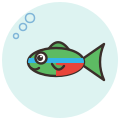
A tiny, slim tetra and the smallest of the three Paracheirodon species. Its glowing stripe is greener than a neon's and runs all the way from the eye to the base of the tail, while the red on the lower flank is paler and less extensive than in the cardinal tetra. Grown females are rounder and slightly bigger than males.23
Personality what they are like
Peaceful and gentle. Because it is so small and likes soft, acidic water, it is happiest in a calm, dedicated tank with other tiny, peaceful species rather than a busy general community.2
Daily activity how busy a day looks
A schooling mid-water swimmer; a densely planted tank with open swimming space suits it.23
Grooming and care the hands-on bits
No grooming needed. Best suited to keepers who can maintain soft, acidic water; most fish in the trade are wild collected rather than farm bred.2
Home where they are happiest
Tank of at least about 45 x 30 cm base. Sources differ on water: FishBase gives 23-27 °C and pH 5.5-6.0 with very soft water (to 4 dH), while Seriously Fish gives 21-35 °C (reflecting warm wild habitats), pH 3.0-6.5 and 1-8 dGH.21
Food basics what goes in the bowl
Omnivore. Offer a varied menu of small dry foods together with live or frozen small invertebrates such as bloodworm, mosquito larvae and Daphnia.2
Company who they like around
Naturally forms schools: buy at least 8-10 together.2
The story where it all began
Jacques Géry first described it in 1963 as Hyphessobrycon simulans. Weitzman and Fink moved it into Paracheirodon in 1983, alongside the neon and cardinal tetras, and later molecular work supported the move. Its species name means 'imitating', a nod to how much it resembles its famous cousins.321
Fun facts for the dinner table
- 1
Its species name simulans means 'imitating', because it looks so much like the neon and cardinal tetras.2
- 2
Its colours fade when the lights go off and switch back on when the lights return.3
- 3
It is the only Paracheirodon species with two separate rows of teeth on the upper jaw bone (premaxilla).3
- 4
In warming experiments it showed 100% survival even in the most extreme conditions tested.3
- 5
Some wild fish naturally carry golden metallic scales.2
Recognised by the official bits
- IUCN Red List
- Least Concern (assessed 4 March 2021)1
- FishBase
- Listed as commercial in the aquarium trade1
The care rhythm Furry Diary remembers it for you
A typical home-care rhythm for a Green Neon Tetra. It is our own starting plan, not a vet's advice, and you can change every line in the app.
- FeedingSmall amounts once or twice a dayevery day
- Temperature checkevery day
- Water changeAbout 25% of the waterevery week
- Water testevery week
- Glass cleanevery week
- Filter rinseRinse in old tank water, never tap waterevery month
You might also like
 Cardinal Tetra
 Neon Tetra
 Black Neon Tetra
Like what we are building? Buy us a coffee.
The breed atlas is free for everyone, with a source on every fact, and it will never show ads. If it helped you, a small tip keeps the research going. Any amount is lovely, and no is a perfectly fine answer too.
Where this comes from
Every breed page shows where each fact comes from. If we got something wrong, sorry, we are pet people, not a science magazine. Tell us at [email protected] and we will fix it.
- FishBase species summary: Paracheirodon simulans (Green neon tetra) fishbase.seused for origin, maximum length, water parameters, natural diet, IUCN status, trade use
- Seriously Fish species profile: Paracheirodon simulans seriouslyfish.comused for aquarium size, water parameters, diet, behaviour, group size, sexing, naming
- Wikipedia: Green Neon Tetra en.wikipedia.orgused for other names, appearance, lifespan, history, fun facts
Checked 2026-09-30. Text is written in our own words from these sources.