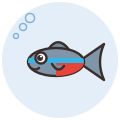
Built-in LED strip.
Neon Tetra
Paracheirodon innesi (Myers, 1936)
Also called Neon, Neonsalmler (German), Hyphessobrycon innesi (original name)
From South America: blackwater and clearwater streams of the western and northern Amazon basin in south-eastern Colombia, eastern Peru and western Brazil, notably tributaries of the Solimoes River. Most aquarium fish today are farm-bred, largely in Southeast Asia.123
At a glance the quick version
Looks how to spot one
Small scaled schooling characin
A slim, torpedo-shaped little fish with a see-through quality to much of its body. A glowing blue-green line runs from the snout to the back of the body near the adipose fin, and below it a bright red band covers the rear half down to the tail. The belly is silvery white. The shine comes from light reflected by tiny guanine crystals in the skin. Females are a little larger and rounder, which makes their blue stripe look slightly bent, while the male's stays straight.134
Personality what they are like
Gentle, lively and completely unaggressive. Neon tetras move around the middle of the tank as a shimmering group and get along with other small, calm fish such as similar-sized tetras, small catfishes and small peaceful cichlids.346
Daily activity how busy a day looks
Active mid-water swimmers that need open swimming space between planted areas. They are busiest and most confident in a larger shoal, and they rest at night, when their colours fade.136
Grooming and care the hands-on bits
Water: about 20 to 28 C in the wild range, with roughly 21 to 25 C being a comfortable aquarium range; pH about 5.0 to 7.0 is preferred (4.0 to 7.5 tolerated), and soft water up to about 10 to 12 dGH. Farm-bred fish adapt to a wider range than wild ones. Keep nitrate low (under about 20 ppm) with regular partial water changes, and quarantine new fish before adding them.123
Home where they are happiest
An aquarium with a base of about 60 x 30 cm (around 54 litres) suits a proper shoal; FishBase also gives 60 cm as the minimum length, while some guides accept 38 litres as an absolute minimum. A planted tank with dark substrate, driftwood, leaf litter and gentle lighting mimics their shaded forest streams and shows off their colours best.321
Food basics what goes in the bowl
Omnivore. Wild neons eat tiny crustaceans, insect larvae, worms, zooplankton and some plant matter or algae. In the aquarium give a quality small flake or micro-pellet as a base, plus frozen or live foods such as bloodworm, daphnia, brine shrimp and mosquito larvae.2316
Company who they like around
A true schooling fish that needs company of its own kind. Keep at least six, and ideally a group of 8 to 12 or more, where they are more active and confident.132
The story where it all began
The neon tetra reached the aquarium world in the mid-1930s. The French collector Auguste Rabaut sent fish from the Amazon near Iquitos in Peru to Europe, where a handful passed through a Paris dealer to aquarists in Hamburg in 1935 for a very high price. In 1936 a few specimens travelled on the airship Hindenburg to the Shedd Aquarium in Chicago. That same year the American ichthyologist George S. Myers described the species scientifically, naming it after William T. Innes, editor of the magazine The Aquarium. The German ichthyologist Werner Ladiges nicknamed it 'swimming gold from the Rio Ucayali' because of its value. Breeding it in captivity was difficult at first because the special needs of the eggs and larvae were not understood, but once the technique was cracked, starting with breeders in Thuringia, the neon became a mass-produced fish. Since the 1960s most neons have come from fish farms in Southeast Asia, including Hong Kong, Singapore and Thailand, and it remains one of the best-known aquarium fish in the world.51
Fun facts for the dinner table
- 1
At night, when the fish is resting, its blue and red colours fade to grey, black or dark violet, then brighten again once it becomes active in the morning.1
- 2
The famous shimmer comes from guanine crystals in skin cells that reflect light differently depending on lighting conditions.1
- 3
Some of the first neon tetras to reach the USA crossed the Atlantic in 1936 aboard the airship Hindenburg, bound for Chicago's Shedd Aquarium.5
- 4
Around two million neon tetras are sold in the United States every month, and fewer than 5 percent of them are wild-caught.1
- 5
Neon tetra eggs hatch in only about 24 to 36 hours, and the fry start swimming freely 3 to 4 days later.3
- 6
Neon tetras can be ready to breed at just 12 weeks of age.1
- 7
The genus name Paracheirodon combines Greek words for 'beside', 'hand' and 'teeth', marking it as a close relative of the genus Cheirodon.6
- 8
The species is named in honour of William T. Innes (1874 to 1969), a pioneering American aquarium writer and magazine editor.5
Recognised by the official bits
- IUCN Red List
- Least Concern (assessed 4 March 2021)2
- Taxonomy
- Type species of the genus Paracheirodon, which also holds the cardinal tetra and green neon tetra; order Characiformes6
- Scientific description
- Described by George S. Myers in 1936 as Hyphessobrycon innesi1
The care rhythm Furry Diary remembers it for you
A typical home-care rhythm for a Neon Tetra. It is our own starting plan, not a vet's advice, and you can change every line in the app.
- FeedingSmall amounts once or twice a dayevery day
- Temperature checkevery day
- Water changeAbout 25% of the waterevery week
- Water testevery week
- Glass cleanevery week
- Filter rinseRinse in old tank water, never tap waterevery month
You might also like
 Cardinal Tetra
 Green Neon Tetra
 Black Neon Tetra
 Ember Tetra
 Rummy-nose Tetra
Like what we are building? Buy us a coffee.
The breed atlas is free for everyone, with a source on every fact, and it will never show ads. If it helped you, a small tip keeps the research going. Any amount is lovely, and no is a perfectly fine answer too.
Where this comes from
Every breed page shows where each fact comes from. If we got something wrong, sorry, we are pet people, not a science magazine. Tell us at [email protected] and we will fix it.
- Neon tetra - Wikipedia en.wikipedia.orgused for taxonomy, range, appearance, lifespan, care, diet, trade figures, colour change
- Paracheirodon innesi summary - FishBase fishbase.seused for water parameters, size, IUCN status, diet, tank size, hatching time
- Paracheirodon innesi - Seriously Fish seriouslyfish.comused for aquarium size, water values, diet, compatibility, group size, breeding, colour
- Neon tetra - Britannica britannica.comused for size, appearance, temperament
- Neonsalmler - Wikipedia (German) de.wikipedia.orgused for discovery and import history, Innes, varieties, lifespan, breeding history
- Paracheirodon - Wikipedia en.wikipedia.orgused for genus members, etymology, diet in the wild
Checked 2026-09-30. Text is written in our own words from these sources.