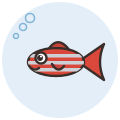
Not furry, but we like them anyway.
Rummy-nose Tetra
Petitella rhodostoma
Also called Rummynose tetra, Rednose tetra, Hemigrammus rhodostomus (former name)
From South America: lower Amazon basin in Pará state, Brazil (type locality on the Rio Tapajós near Santarém). Older sources also list the Orinoco basin, though those records likely belong to the closely related firehead tetra.123
At a glance the quick version
Looks how to spot one
Small, slender scaled characin
A slim, torpedo-shaped tetra with a see-through silvery body that carries a faint green sheen. Its face is washed in a rich ruby red that reaches into the eye and back past the gill cover. The tail fin is the other giveaway: bold black and white bands run lengthwise, with one black stripe through the centre and two more on each lobe. Males and females look alike, though a female carrying eggs looks plumper.312
Personality what they are like
Calm and sociable. Rummy-noses swim close together in a neat shoal, both in the wild and in tanks, and they mix well with other peaceful fish such as small South American tetras, dwarf cichlids, corydoras and rasboras. Boisterous or aggressive tankmates are best avoided.23
Daily activity how busy a day looks
An active midwater swimmer that spends its day cruising as a group, so it needs open swimming space along the length of the tank. Sources suggest a tank of at least 80 to 90 cm in length.12
Grooming and care the hands-on bits
Keep the water clean and stable with regular partial water changes. Soft, slightly acidic water suits it best: temperature about 24 to 27 °C (some sources allow up to 31 °C), pH roughly 5.5 to 7.4 with 6.4 to 7.0 often cited as ideal, and soft to moderately hard water (about 2 to 15 dGH, with some keepers aiming for 6 dH or lower). Colours tend to look less intense in alkaline water.23
Home where they are happiest
In nature it lives in blackwater rivers and streams, where tannins stain the water tea-brown. A planted tank with soft, slightly acidic water, gentle lighting, and some driftwood or leaf litter recreates this well. A tank of at least 80 to 90 cm in length is recommended for a proper shoal.213
Food basics what goes in the bowl
An omnivore that happily takes good-quality flakes and small granules. Add small live or frozen foods such as bloodworm and Daphnia, ideally at least once a week, for variety.23
Company who they like around
A true shoaling fish that should never be kept alone. Recommendations range from a minimum of 5 or 6 up to 10 or more; a larger group gives the best schooling display and the most relaxed fish.123
The story where it all began
German zoologist Ernst Ahl first described the rummy-nose tetra in 1924 under the name Hemigrammus rhodostomus, from fish collected on the Rio Tapajós near Santarém in Brazil. For decades it shared the common name with two lookalikes: the firehead tetra (Petitella bleheri) and the false rummy-nose tetra (Petitella georgiae). The genus Petitella was created in 1964 by French ichthyologists Jacques Géry and Henri Boutière for the false rummy-nose alone. In 2020 a molecular study showed the three red-nosed tetras belong together, and the rummy-nose was moved into Petitella as Petitella rhodostoma. It has long been a staple of the aquarium trade and remains one of the best-known schooling fish for planted community tanks.3421
Fun facts for the dinner table
- 1
Its red face works like a built-in water test: when water quality slips, the ruby colour fades to a paler shade, so keepers use it as an early hint to check the tank.3
- 2
The tail fin is striped lengthwise in black and white, with a central black band and two more on each lobe, giving it a checkered look.3
- 3
There are three almost identical 'rummy-nose' tetras: the true rummy-nose, the firehead tetra and the false rummy-nose, and they are often mixed up in shops.2
- 4
After nearly a century in the genus Hemigrammus, it was moved to Petitella in 2020 thanks to DNA-based research.4
- 5
Its babies are among the slowest-growing of all characins, and can take up to around 12 weeks before they accept larger foods.3
- 6
It is famous for schooling tightly together, both in the wild and in home aquariums.3
Recognised by the official bits
- FishBase
- Listed as Petitella rhodostoma (Ahl, 1924); commercial importance in the aquarium trade; IUCN status shown as Not Evaluated1
- IUCN Red List
- Shown as Least Concern on Wikipedia (FishBase lists Not Evaluated)3
- Taxonomy
- Described by Ernst Ahl in 1924 as Hemigrammus rhodostomus; moved to the genus Petitella in 2020 after a molecular study4
The care rhythm Furry Diary remembers it for you
A typical home-care rhythm for a Rummy-nose Tetra. It is our own starting plan, not a vet's advice, and you can change every line in the app.
- FeedingSmall amounts once or twice a dayevery day
- Temperature checkevery day
- Water changeAbout 25% of the waterevery week
- Water testevery week
- Glass cleanevery week
- Filter rinseRinse in old tank water, never tap waterevery month
You might also like
 Cardinal Tetra
 Neon Tetra
Like what we are building? Buy us a coffee.
The breed atlas is free for everyone, with a source on every fact, and it will never show ads. If it helped you, a small tip keeps the research going. Any amount is lovely, and no is a perfectly fine answer too.
Where this comes from
Every breed page shows where each fact comes from. If we got something wrong, sorry, we are pet people, not a science magazine. Tell us at [email protected] and we will fix it.
- FishBase: Petitella rhodostoma, Rummy-nose tetra fishbase.seused for origin, max length, minimum tank size, group size, taxonomy, trade importance
- Seriously Fish: Hemigrammus rhodostomus seriouslyfish.comused for habitat, water parameters, diet, tankmates, group size, lookalike species
- Wikipedia: Rummy-nose tetra en.wikipedia.orgused for description, lifespan, taxonomy history, water parameters, diet, fun facts
- Wikipedia: Petitella en.wikipedia.orgused for genus history and 2020 reclassification
Checked 2026-09-30. Text is written in our own words from these sources.