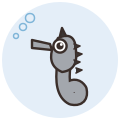
Not furry, but we like them anyway.
Lined Seahorse
Hippocampus erectus Perry, 1810
Also called Northern seahorse, Spotted seahorse
From Western Atlantic, from Nova Scotia to Venezuela and Brazil, including the Gulf of Mexico, the Caribbean and the US east coast. Aquarium fish are usually captive-bred.123
At a glance the quick version
Adults usually 12 to 17 cm; maximum recorded about 19 cm.
One to four years in the wild; around four years is typical in captivity.
Looks how to spot one
Bony-plated seahorse
An upright seahorse whose body is armoured in roughly fifty bony plates. Fine white lines trace the neck and tiny white dots speckle the tail, and a crown-like coronet tops the head. Colour is highly variable and adapts to its surroundings.23
Personality what they are like
Peaceful and unhurried. Pairs bond for life and renew their bond each morning with a short dance, and they make soft clicking sounds with the coronet.23
Daily activity how busy a day looks
A slow, upright swimmer that beats its small fins very quickly and spends most of its time anchored by its prehensile tail to grasses and other holdfasts.23
Grooming and care the hands-on bits
Rated difficult. It needs calm, clean water, several small meals a day and prompt removal of leftover food. Captive-bred fish already eat frozen foods.32
Home where they are happiest
A tall species aquarium (at least about 40 cm high) of about 115 litres (30 US gallons) for a pair, with gentle flow and plenty of hitching posts. Water about 20 to 26 °C, pH 8.1 to 8.4, dKH 8 to 12, specific gravity 1.020 to 1.025.32
Food basics what goes in the bowl
Small crustaceans such as frozen mysis shrimp, offered two or more times a day. It suction-feeds through its long snout.321
Company who they like around
Best kept as a mated pair or a small group of its own kind in a species-only tank, away from fast or boisterous fish.32
The story where it all began
George Perry described the species in 1810. It is the only seahorse native to Chesapeake Bay, and it has been bred in captivity for many years, supplying most aquarium fish.21
Fun facts for the dinner table
Recognised by the official bits
- IUCN Red List
- Vulnerable (assessed 3 October 2016)1
- CITES
- Appendix II1
- Taxonomy
- Family Syngnathidae; described by George Perry in 18102
The care rhythm Furry Diary remembers it for you
A typical home-care rhythm for a Lined Seahorse. It is our own starting plan, not a vet's advice, and you can change every line in the app.
- FeedingSmall amounts once or twice a dayevery day
- Temperature checkevery day
- Salinity checkevery week
- Top-upTop up evaporation with fresh RO water, not salt waterevery day
- Water testevery week
- Water changeAbout 10 to 20% of the waterevery 2 weeks
- Glass cleanevery week
You might also like
 Kuda Seahorse
 Dwarf Seahorse
Like what we are building? Buy us a coffee.
The breed atlas is free for everyone, with a source on every fact, and it will never show ads. If it helped you, a small tip keeps the research going. Any amount is lovely, and no is a perfectly fine answer too.
Where this comes from
Every breed page shows where each fact comes from. If we got something wrong, sorry, we are pet people, not a science magazine. Tell us at [email protected] and we will fix it.
- FishBase: Hippocampus erectus summary fishbase.seused for distribution, depth, length, gestation, IUCN and CITES status, captive rearing
- Wikipedia: Lined seahorse en.wikipedia.orgused for names, description, colours, behaviour, lifespan, reproduction, fun facts
- LiveAquaria: Lined Seahorse, Captive-Bred liveaquaria.comused for aquarium care level, tank size, water parameters, diet, tankmates
Checked 2026-09-30. Text is written in our own words from these sources.