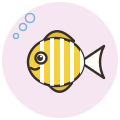
Not furry, but we like them anyway.
Yellow Tang
Zebrasoma flavescens (Bennett, 1828)
Also called Lemon sailfin, Yellow sailfin tang, Lau'ipala (Hawaiian)
From Pacific Ocean reefs, chiefly the Hawaiian Islands, plus the Ryukyu, Mariana, Marshall, Marcus and Wake islands. It favours subtropical waters and is largely absent from the warmest equatorial seas.123
At a glance the quick version
About 10 years recorded in captivity (ADW); estimates for wild fish run from 30 to 40 years or more.
Looks how to spot one
Scaled, disc-shaped surgeonfish
A flat, tall, almost round fish with a pointed, slightly down-turned snout and tall dorsal and anal fins that make it look like a little yellow sail. The whole body is bright lemon yellow, broken only by a white, blade-like spine on each side just in front of the tail. After dark the colour dulls to a greyish yellow, a brownish patch appears on the side and a pale horizontal stripe shows along the body, then the full yellow returns quickly in daylight.253
Personality what they are like
Lively and confident. Young fish tend to guard a patch of reef and can be pushy, while adults are calmer and either wander alone or in small loose groups. It can stand up for itself towards other tangs, especially ones with a similar body shape, so tank mates are best chosen with that in mind.542
Daily activity how busy a day looks
A daytime fish that spends most of its waking hours swimming and grazing over rock surfaces, then tucks into a crevice to sleep at night. It appreciates open swimming room plus plenty of rock to pick at.53
Grooming and care the hands-on bits
Marine reef fish kept in a mature saltwater aquarium. Typical reef-tank conditions are 24-27 C, salinity 1.022-1.025 specific gravity and pH around 8.2, which overlaps the 24-28 C water it lives in on the reef. Offer regular algae-based meals and keep water quality stable. The tail spines are sharp, so use a net or container rather than bare hands when moving it.6132
Home where they are happiest
In the wild it lives on coral-rich lagoon and outer reefs from about 2 to 46 m deep. In the home a roomy marine tank with lots of live rock for grazing and night-time hiding spots, plus open water to cruise, suits it best. No minimum tank volume from a primary source was found.153
Food basics what goes in the bowl
Mainly a plant eater. It browses filamentous algae and seaweed off rocks and coral with comb-like teeth, and takes a little zooplankton too. In aquariums a mix that is mostly marine algae and seaweed, with some meaty food, is recommended.1532
Company who they like around
Found singly or in small, loose groups. Young fish are more territorial than adults, and it may squabble with other tangs, so give it space and pick companions carefully.1542
The story where it all began
Edward Turner Bennett, an English naturalist, described the species in 1828 as Acanthurus flavescens from fish collected in Hawaii; its name comes from the Latin for yellow. It went on to become one of the most popular marine aquarium fish in the world, and for years Hawaii was its main source, with the species being the islands' top marine fish export. In response to falling numbers on some reefs, Hawaii set up protected Fish Replenishment Areas around 2000, and larvae drifting out of those zones helped reseed fished areas. Hawaii stopped issuing aquarium collection permits in January 2021, and prices for wild fish rose sharply. Captive breeding work in Hawaii (the Oceanic Institute, linked with Hawaii Pacific University) produced its first captive-raised yellow tangs in 2015, and tank-bred fish are now offered in the hobby.2143
Fun facts for the dinner table
- 1
Its Hawaiian name, Lau'ipala, refers to a yellowed ti leaf.3
- 2
It changes outfits at night: the bright yellow fades to greyish yellow with a pale stripe along its side, then returns in the morning.3
- 3
Yellow tangs act as cleaners for green sea turtles, nibbling algae off their shells.2
- 4
Spawning peaks around the full moon, and a female may release around 40,000 eggs at a time.5
- 5
Its larvae can drift more than 160 km (100 miles) on ocean currents before settling on a reef.2
- 6
Like all surgeonfish it carries a scalpel-like spine on each side of the tail base, which it shows off as a warning.5
- 7
It is the only solid-yellow reef fish found in Hawaii.3
Recognised by the official bits
- IUCN Red List
- Least Concern (assessed 7 May 2010)1
- Taxonomy
- Family Acanthuridae (surgeonfishes); first described as Acanthurus flavescens by Edward Turner Bennett in 1828 from Hawaiian specimens2
The care rhythm Furry Diary remembers it for you
A typical home-care rhythm for a Yellow Tang. It is our own starting plan, not a vet's advice, and you can change every line in the app.
- FeedingSmall amounts once or twice a dayevery day
- Temperature checkevery day
- Salinity checkevery week
- Top-upTop up evaporation with fresh RO water, not salt waterevery day
- Water testevery week
- Water changeAbout 10 to 20% of the waterevery 2 weeks
- Glass cleanevery week
You might also like
 Blue Tang
 Purple Tang
 Sailfin Tang
Like what we are building? Buy us a coffee.
The breed atlas is free for everyone, with a source on every fact, and it will never show ads. If it helped you, a small tip keeps the research going. Any amount is lovely, and no is a perfectly fine answer too.
Where this comes from
Every breed page shows where each fact comes from. If we got something wrong, sorry, we are pet people, not a science magazine. Tell us at [email protected] and we will fix it.
- FishBase: Zebrasoma flavescens summary fishbase.seused for distribution, habitat, depth, max length, diet, IUCN status, spawning, water temperature, trade
- Wikipedia: Yellow tang en.wikipedia.orgused for taxonomy, description, history, captive breeding, Hawaii trade and ban, turtle cleaning, larval drift
- Waikiki Aquarium (University of Hawaii): Yellow Tang waikikiaquarium.orgused for Hawaiian name, range, teeth and grazing, night colour, spine
- Aquarium of the Pacific: Yellow Tang aquariumofpacific.orgused for size, wild lifespan estimates, behaviour, conservation, captive breeding
- Animal Diversity Web (University of Michigan): Zebrasoma flavescens animaldiversity.orgused for lifespan, colour, behaviour, diet, defence, eggs
- Wikipedia: Reef aquarium en.wikipedia.orgused for general reef aquarium water parameters
Checked 2026-09-30. Text is written in our own words from these sources.