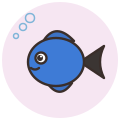
Not furry, but we like them anyway.
Blue Tang
Paracanthurus hepatus (Linnaeus, 1766)
Also called Regal tang, Palette surgeonfish, Hippo tang, Blue hippo tang, Regal blue tang
From Indo-Pacific coral reefs, from East Africa and the Mascarene Islands east to Kiribati, north to southern Japan and south to the Great Barrier Reef, New Caledonia and Samoa.12
At a glance the quick version
Adults average 25-31 cm. FishBase gives 31 cm as maximum; Aquarium of the Pacific and ADW give a range of 12-38 cm.
Usually 8-12 years in aquariums, sometimes up to 20 (ADW); wild fish average 12-14 years and may pass 30.
Looks how to spot one
Scaled, oval surgeonfish
An oval, flattened fish in rich royal blue, with a bold black pattern along the upper body that loops round to leave a blue patch on each side, a bit like an artist's palette. The tail is bright yellow in a triangle shape, and the pectoral fins are tipped yellow too. Young fish start out mostly yellow with blue near the eyes. A small, sharp spine sits on each side of the tail base. The blue becomes paler at night.24
Personality what they are like
Energetic and a bit shy at first. It likes to have a crevice or branching coral it can dash into when startled, and young fish in particular hide quickly. Males can be competitive with each other, circling and showing off their tail spines, so they do best with peaceful, non-look-alike company.43
Daily activity how busy a day looks
A strong, daytime swimmer that in the wild lives on clear outer reef slopes with moderate to strong current. It enjoys long open stretches to swim plus good water movement.12
Grooming and care the hands-on bits
Marine reef fish for an established saltwater aquarium. Typical reef-tank conditions are 24-27 C, salinity 1.022-1.025 specific gravity and pH around 8.2. Feed a varied diet several times a day, keep water stable, and provide strong water flow. Its tail spines are sharp, so move it with a container rather than bare hands. Nearly all blue tangs sold are still wild-caught, so choosing captive-bred fish when available supports wild reefs.5432
Home where they are happiest
Lives near the bottom on current-swept terraces of seaward reefs at about 2 to 40 m, using branching coral as cover. At home it needs a large, long marine tank with plenty of swimming space, solid rockwork with hiding places and strong flow. No minimum tank volume from a primary source was found.124
Food basics what goes in the bowl
An omnivore. Young fish eat mostly plankton, while adults feed on zooplankton and graze filamentous algae and microalgae from rocks and coral. A mix of marine algae and small meaty foods covers both sides.124
Company who they like around
Lives in pairs or loose groups of roughly 8 to 14 fish, and juveniles school near coral heads. Males can be rivals, so in home tanks one fish or a carefully planned group in a very large tank is usual.213
The story where it all began
Carl Linnaeus named the species in 1766, and it remains the only member of its genus. It has long been a favourite of marine aquarists and ranks among the most traded aquarium fish worldwide, with an estimated 95,000 imported in 2011, almost all collected from the wild. Fame came in 2003 when Dory, the forgetful and cheerful blue tang in Finding Nemo, made it one of the best known fish on the planet, followed by Finding Dory in 2016. Research later found that online interest jumped after the second film but imports did not rise noticeably. In 2016 biologist Kevin Barden of Rising Tide Conservation, working with the University of Florida, raised blue tangs in captivity for the first time after about six years of effort, a step towards farmed fish for the hobby.21
Fun facts for the dinner table
- 1
Dory from Finding Nemo (2003) and Finding Dory (2016) is a blue tang.2
- 2
When frightened, a blue tang may 'play dead', lying still on its side.4
- 3
It is the only species in its genus, Paracanthurus.2
- 4
Baby blue tangs are mostly yellow and only turn blue as they grow.4
- 5
The black marking on its side is said to look like a painter's palette, giving it the name palette surgeonfish.2
- 6
A female can release up to about 40,000 eggs at once, and they hatch in roughly a day.3
- 7
It goes by at least a dozen common names, from hippo tang to wedge-tailed tang.2
- 8
The first captive-bred blue tangs were raised in 2016 after about six years of research.2
Recognised by the official bits
- IUCN Red List
- Least Concern (assessed 7 May 2010)1
- Taxonomy
- Only species in the genus Paracanthurus, family Acanthuridae; described by Linnaeus in 1766. Its closest relatives are the Zebrasoma tangs.2
Popularity Ranked the 8th most traded aquarium fish species worldwide; about 95,000 imported in 2011.
The care rhythm Furry Diary remembers it for you
A typical home-care rhythm for a Blue Tang. It is our own starting plan, not a vet's advice, and you can change every line in the app.
- FeedingSmall amounts once or twice a dayevery day
- Temperature checkevery day
- Salinity checkevery week
- Top-upTop up evaporation with fresh RO water, not salt waterevery day
- Water testevery week
- Water changeAbout 10 to 20% of the waterevery 2 weeks
- Glass cleanevery week
You might also like
 Yellow Tang
 Powder Blue Tang
Like what we are building? Buy us a coffee.
The breed atlas is free for everyone, with a source on every fact, and it will never show ads. If it helped you, a small tip keeps the research going. Any amount is lovely, and no is a perfectly fine answer too.
Where this comes from
Every breed page shows where each fact comes from. If we got something wrong, sorry, we are pet people, not a science magazine. Tell us at [email protected] and we will fix it.
- FishBase: Paracanthurus hepatus summary fishbase.seused for names, distribution, habitat, depth, max length, diet, IUCN status, aquarium trade
- Wikipedia: Paracanthurus en.wikipedia.orgused for names, taxonomy, description, weight, social structure, captive breeding, trade figures, Finding Nemo/Dory
- Aquarium of the Pacific: Palette Surgeonfish aquariumofpacific.orgused for size, wild lifespan, behaviour, spawning, eggs
- Animal Diversity Web (University of Michigan): Paracanthurus hepatus animaldiversity.orgused for lifespan, size, weight, colour, juvenile colour, hiding and playing dead
- Wikipedia: Reef aquarium en.wikipedia.orgused for general reef aquarium water parameters
Checked 2026-09-30. Text is written in our own words from these sources.