At a glance the quick version
Adult females about 8-10 cm; the rare males are slimmer at about 5-6 cm
Adults live about a year, after roughly 3-8 months of growing up as nymphs
Looks how to spot one
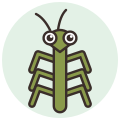
Wingless, twig-like exoskeleton
A long, thin, wingless insect that looks like a small twig. Adult females carry a red patch on the inner base of the front legs and a yellow patch on the middle legs. Newly hatched young are tiny, dark and thread-like.132
Personality what they are like
Calm and slow-moving. It spends the day resting quietly on its food plant and becomes active and feeds after dark. When disturbed it may go stiff and still, which is part of its camouflage rather than any sign of stress to the keeper.14
Daily activity how busy a day looks
Very low. The insect feeds and moves mainly at night and needs only enough climbing space among its food plants.1
Grooming and care the hands-on bits
Mist the inside of the enclosure and the food leaves lightly each evening with lukewarm water. Keep cut food stems in a water pot with the opening covered so nymphs cannot fall in. Move insects gently with a soft paintbrush rather than pulling them from a perch, as legs can come off. A lost leg can regrow at the next moult while the insect is still a nymph. Females lay eggs freely, so collect them from the floor if you want to hatch more; eggs can take from about two months to a year to hatch.453
Home where they are happiest
A ventilated enclosure at least three times as tall as the adult insect (30 cm or more is a good minimum) so it can hang to moult. Normal home temperatures of about 17 C and above suit it, and it is happy in a fairly open, airy cage. Keep it out of direct sunlight and away from overheating spots such as greenhouses.45
Food basics what goes in the bowl
Fresh leaves only. Bramble (blackberry) is the staple, and privet, ivy, hawthorn, rose, raspberry, pyracantha and oak are also eaten. Wash leaves and offer them on stems kept in water so they stay fresh for several days.2543
Company who they like around
Peaceful with its own kind and commonly kept in small groups. Because females reproduce without males, a group grows on its own unless eggs are removed.43
The story where it all began
The species was formally described in 1901 by Sinéty. The insects kept around the world today descend from culture stocks that came from Tamil Nadu in southern India, and nearly all of them are females that reproduce by laying unfertilised eggs. Their easy care made them a classic laboratory and classroom insect, which is where the name laboratory stick insect comes from, and they became the first species on the Phasmid Study Group culture list, numbered PSG 1. Escaped or released insects have also settled outdoors in a few places outside India, including parts of Great Britain, Portugal, South Africa and the United States, where they have been recorded on ornamental garden plants.1267
Fun facts for the dinner table
- 1
Males are so rare that there is usually only about one male for every 500 to 1,000 females; the females lay unfertilised eggs that hatch into more females.3
- 2
A single female can lay up to about three eggs a day and around 1,200 eggs over her life.3
- 3
It is one of the few stick insects able to shift its colouring to blend in with its surroundings, from light green to dark brown.7
- 4
When threatened it plays dead: the body goes rigid and the legs are pressed forward along the body so it looks just like a twig.1
- 5
It sways gently from side to side as it walks, copying a twig moving in the breeze.1
- 6
Its species name morosus comes from 'morose', a nod to its plain, drab look.2
- 7
It holds number 1 on the Phasmid Study Group culture list.2
- 8
A nymph that loses a leg can grow it back at its next moult.4
Recognised by the official bits
- Phasmid Study Group
- Culture number PSG 1, listed as a common culture species from India (described by Sinéty, 1901)2
The care rhythm Furry Diary remembers it for you
A typical home-care rhythm for a Indian Stick Insect. It is our own starting plan, not a vet's advice, and you can change every line in the app.
- Humidity checkevery 2 days
- Water dishevery 2 days
- FeedingDepends on species, size and moult stagevaries
- Spot cleanRemove leftover foodevery week
- Moult noteLeave them in peace while moulting and note it in the diaryvaries
- Substrate changeevery 6 months
You might also like
 Giant Prickly Stick Insect
 Jungle Nymph Stick Insect
Like what we are building? Buy us a coffee.
The breed atlas is free for everyone, with a source on every fact, and it will never show ads. If it helped you, a small tip keeps the research going. Any amount is lovely, and no is a perfectly fine answer too.
Where this comes from
Every breed page shows where each fact comes from. If we got something wrong, sorry, we are pet people, not a science magazine. Tell us at [email protected] and we will fix it.
- Carausius morosus - Wikipedia en.wikipedia.orgused for origin, size, colours, defence behaviour, introduced populations
- Carausius morosus (Sinéty, 1901) - Phasmid Study Group phasmid-study-group.orgused for PSG number, sizes, food plants, name meaning, reproduction
- Indische Stabschrecke - Wikipedia (German) de.wikipedia.orgused for male size, lifespan, moults, development time, egg numbers, male rarity, food plants
- Stick insects care sheet - Amateur Entomologists' Society amentsoc.orgused for temperature, cage height, misting, handling, leg regrowth
- Looking After Stick Insects - Phasmid Study Group phasmid-study-group.orgused for enclosure, light, feeding, handling, egg care
- PSG Culture List - Phasmid Study Group phasmid-study-group.orgused for culture listing details
- Phasmatodea - Wikipedia en.wikipedia.orgused for colour change, lab stick insect note
Checked 2026-09-30. Text is written in our own words from these sources.