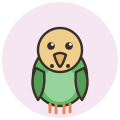
Tiny bird, big vocabulary.
Budgerigar
Melopsittacus undulatus
Also called Budgie, Common parakeet, Shell parakeet, Parakeet
From Australia, across the drier inland of the mainland (absent from Tasmania, the far south-west, the northern Northern Territory and most of the east coast)12
At a glance the quick version
Wingspan about 30 cm.
Typical pet lifespan is 5-8 years; ages of 15-20 years have been reported.
Looks how to spot one
feathers
A small, slim parrot with a long, tapering tail. The wild form is grass green below, with a yellow face and forehead and a back and wings covered in fine black wavy barring edged with yellow. Each cheek carries a small violet-blue patch and there is a row of small black spots across the throat. The fleshy band above the beak (the cere) usually turns blue in adult males and brownish or pale in adult females, which is the usual way to tell the sexes apart.213
Personality what they are like
Budgies are lively, curious flock birds that chatter and warble for much of the day. They are happiest with company of their own kind and, when handled gently and patiently, many become tame enough to perch on a hand. Males in particular often pick up words, phrases and household sounds.256
Daily activity how busy a day looks
Wild budgies are nomadic and fly long distances in flocks, so pet birds need plenty of flying. The RSPCA advises at least six hours outside the cage every day in a safe, bird-proofed room, plus toys and perches that encourage climbing and exploring.712
Grooming and care the hands-on bits
Budgies preen themselves; offer a shallow water dish or gentle mist for bathing. Provide natural wooden perches of different thicknesses and angles, and keep the cage clean with fresh food and water every day.7
Home where they are happiest
RSPCA guidance: a cage for a bird that spends most time inside it should be at least twice the bird's wingspan in height, width and depth (at least 1.5 times if the bird spends most time out of the cage), with about 5% more space per extra small bird. Aviaries should be at least four times the largest bird's wingspan, with a sheltered indoor section and shade outdoors. Keep birds between about 12 and 26 C and consider flicker-free UV lighting.7
Food basics what goes in the bowl
In the wild they eat mostly small grass and herb seeds, such as spinifex (porcupine grass) and saltbush, picked from the ground, and they drink every day. For pets the RSPCA suggests a quality pellet as the main food (about three quarters), fresh vegetables and some fruit (about a quarter, e.g. carrot, broccoli, peas, deseeded apple), and seed only as a small part (no more than about a tenth). Fresh water always. Avocado must never be fed.318
Company who they like around
A highly social flock species. Keep budgies in pairs or small groups with enough room for every bird to fly and to move away from the others when it wants to.653
The story where it all began
Budgerigars are native to inland Australia, where Aboriginal peoples knew them long before Europeans arrived; the English name is thought to come from a Gamilaraay word. The species was first described scientifically by George Shaw in 1805, and the naturalist John Gould gave it much wider fame in 1840 after bringing live birds to Britain. Europeans began breeding them in captivity in the 1850s, and the first colour mutations soon followed: a yellowish 'suffused green' appeared in the 1870s and the first sky-blue birds in Belgium between about 1878 and 1885. Darker shades, grey, violet, pied, opaline and many other varieties arose in the early 20th century. Specialist societies such as the UK Budgerigar Society developed the larger, rounder exhibition type, while the smaller wild-type bird remains the familiar pet in many countries.249
Fun facts for the dinner table
- 1
A male budgie named Puck was credited by Guinness World Records (1995) with a vocabulary of 1,728 words, the largest known for any bird.2
- 2
Budgie plumage glows under ultraviolet light, and the birds can see UV colours that humans cannot.2
- 3
After a season of heavy rain, wild budgies can gather in flocks of tens of thousands of birds.3
- 4
Breeders have recorded at least 32 basic colour mutations, which combine into hundreds of different-looking varieties.4
- 5
The sky-blue budgie first appeared in Belgium around 1878-1885 but did not reach England until 1910.4
- 6
Wild budgies breed whenever rain brings food, nesting in bare tree hollows and laying clutches of about 6-8 white eggs.1
- 7
Their flight is described as undulating, and the species' scientific name 'undulatus' refers to the wavy barring on its feathers.1
Recognised by the official bits
- The Budgerigar Society (UK)
- Specialist society for exhibition budgerigars; publishes the 'Standard for the Colour Budgerigar' and an 'Ideal Budgerigar' picture standard (2025 edition) used for judging shows.9
- IUCN Red List (via BirdLife Australia)
- The wild species is assessed as Least Concern.3
The care rhythm Furry Diary remembers it for you
A typical home-care rhythm for a Budgerigar. It is our own starting plan, not a vet's advice, and you can change every line in the app.
- Fresh food and waterevery day
- Cage linerevery 2 days
- Full cleanevery week
- Bath offerA shallow dish or gentle mistevery 3 days
- Nails checkevery month
- Toy rotationevery 2 weeks
- Out-of-cage timeAbout an hour a day, if tameevery day
- Vet check-upevery year
You might also like
 Cockatiel
 Lovebird
 Bourke's Parakeet
 Canary
Like what we are building? Buy us a coffee.
The breed atlas is free for everyone, with a source on every fact, and it will never show ads. If it helped you, a small tip keeps the research going. Any amount is lovely, and no is a perfectly fine answer too.
Where this comes from
Every breed page shows where each fact comes from. If we got something wrong, sorry, we are pet people, not a science magazine. Tell us at [email protected] and we will fix it.
- Budgerigar - Australian Museum australian.museumused for range, size, habitat, diet, breeding, colour varieties, flight
- Budgerigar - Wikipedia en.wikipedia.orgused for names, size, weight, lifespan, history, cere sexing, fun facts
- Budgerigar - BirdLife Australia birdlife.org.auused for size, weight, diet, flocking, IUCN status
- Budgerigar colour genetics - Wikipedia en.wikipedia.orgused for colour mutation history and varieties
- RSPCA - Pet birds rspca.org.ukused for general care overview
- RSPCA - Bird company rspca.org.ukused for social needs
- RSPCA - Bird environment rspca.org.ukused for cage and aviary size, flight time, perches, temperature, lighting
- RSPCA - Bird diet rspca.org.ukused for pet diet
- The Budgerigar Society budgerigarsociety.comused for exhibition standards
Checked 2026-09-30. Text is written in our own words from these sources.